 ultimate-guide
Efficient Security Solutions for Hospitality Services
Table of Contents
- Why Hospitality Security Demands a Different Approach
- Core Components of Efficient Hospitality Security Solutions
- Access Control and Entry Management
- Real-Time Monitoring and CCTV Coverage
- Visitor Management Systems
- Data Security and Privacy Compliance
- Emergency Alarm and Response Protocols
- Digital Key and Contactless Solutions
- Operational Efficiency and Cost Reduction
- Staff and Guest Safety Zones
- Scalable Security Infrastructure
- Hotel Access Control System Best Practices
- Hospitality Security Risk Assessment Checklist
- Changing Locks for Airbnb Property Managers
- Staff Training and Human Factors in Hospitality Security
- Post-Incident Recovery Protocols for Hospitality Properties
- Frequently Asked Questions
Last Updated: September 27, 2026
Why Hospitality Security Demands a Different Approach
Hospitality security is the practice of protecting guests, staff, and property in hotels, short-term rentals, and commercial venues without making people feel watched. It differs from standard commercial security because the same building must stay open and accessible at 2 AM while keeping unauthorized people out.
Core Components of Efficient Hospitality Security Solutions
Efficient security solutions for hospitality services rest on five interlocking layers: access control, real-time monitoring, visitor management, data and privacy protection, and emergency response. Treat them as one system, not five purchases, a gap in any layer forces the others to compensate, and they usually can't.
Access Control and Entry Management
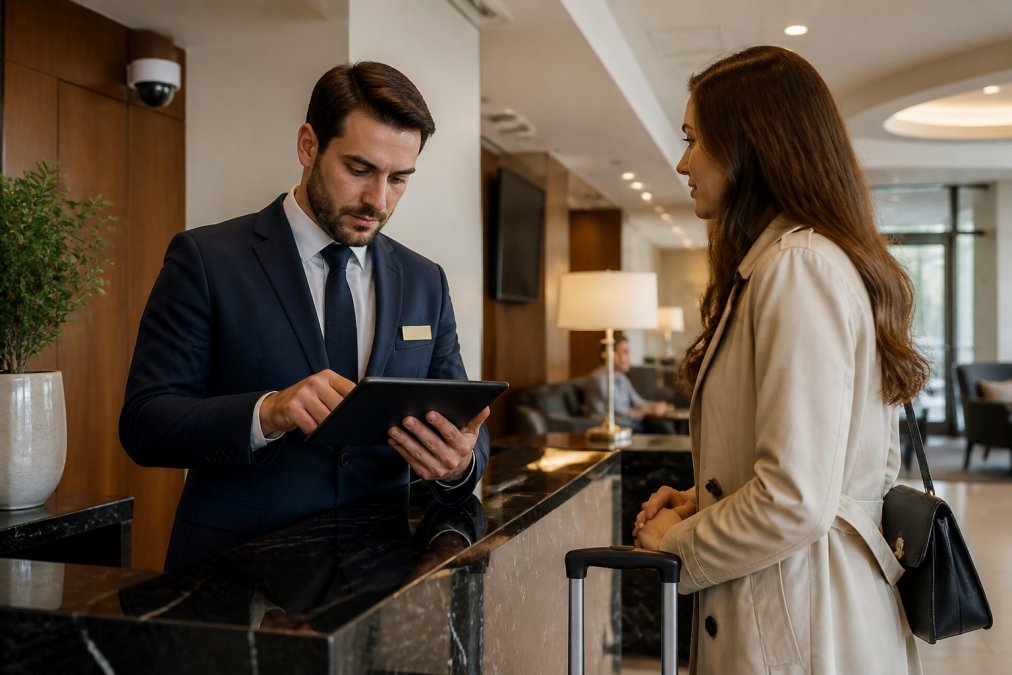
Access control decides who gets in, where, and when: key cards, digital badges, smart locks, PIN entry, and mobile credentials, all tied to a property management system (PMS) so a front-desk checkout automatically expires the room credential.
- Tiered permissions. Housekeeping gets floor-level access during shift hours only. Maintenance gets all-access during scheduled work orders. Contractors get time-boxed credentials that die at the end of the job. Front desk gets override authority, logged.
- Automatic expiration. Credentials should expire on a schedule, not on a manager's memory. A guest code that lives past checkout is a liability.
- Readable audit trails. If pulling a door history requires a vendor service call, you don't own your data. You rent it.
Real-Time Monitoring and CCTV Coverage
CCTV coverage is only useful if someone reviews it before an incident, not after. Modern systems flag motion in restricted zones and push alerts to a phone, the difference between a recording and a response.
Visitor Management Systems
A visitor log is a security control, not a courtesy. Paper sheets can be flipped or ignored. A digital visitor management system captures name, purpose, host, time-in, time-out, and a photo, and can screen against a watchlist before the badge prints.
Data Security and Privacy Compliance
Every credential, camera feed, and visitor record is personal data, which puts hospitality security squarely inside privacy obligations. Map where that data lives, who can see it, and how long it is retained, footage of identifiable guests, key-card logs tied to names, and ID scans all carry retention and access rules.
Emergency Alarm and Response Protocols
Alarms only work if the person who hears them knows what to do. Document, post, and rehearse lockdown, evacuation, and medical-response procedures, and tie alarms to specific zones so a back-of-house door alarm doesn't trigger a full-property evacuation.
Digital Key and Contactless Solutions
Mobile credentials and contactless entry reduce front-desk friction and eliminate lost key cards, but shift risk: a phone can be lost, shared, or compromised. Mitigate as with physical keys, short-lived credentials, device binding, and a fast revocation path.
Operational Efficiency and Cost Reduction
Efficiency in hospitality security isn't about spending less, it's about spending once on systems that remove manual work. Automated credential issuance, remote lock management, and cloud audit logs cut the labor hours once spent on key handoffs and rekeying. Those hours are the real return.
Staff and Guest Safety Zones
Segment the property by risk. Guest rooms and corridors are low-friction, high-trust zones; back-of-house, loading docks, and mechanical rooms are restricted; pool decks, gyms, and parking structures sit in between. Each zone gets its own access rule, camera coverage, and response protocol, a blanket policy fails all three.
Scalable Security Infrastructure
A system that works for one property should extend to ten without a rebuild. Cloud-managed access control, standardized hardware, and a single credential platform let a portfolio add units without a parallel security stack. If each new property needs its own vendor and dashboard, you have fragmentation, not infrastructure.
Hotel Access Control System Best Practices
The best hotel access control systems share three traits: tiered permissions, automatic expiration, and audit trails a manager can read without training.
Here's the part operators learn the hard way:
- Never issue a master credential that can't be revoked in under 60 seconds
- Rotate cleaning staff codes weekly, not quarterly
- Test every override path once a month, on a slow Tuesday
- Keep a printed fallback procedure for the day the network drops
Hospitality Security Risk Assessment Checklist
A hospitality security risk assessment is a structured walk-through that scores every entry point, blind spot, and response gap. The goal is a ranked list, not a report.
- Every exterior door: does it latch fully, and does it log entries?
- Key and credential inventory: who holds what, and when was it last rotated?
- Camera coverage: which hallways, stairwells, and service corridors are blind?
- Visitor log: is it digital, or a paper sheet anyone can flip through?
- Emergency exits: do they alarm when opened outside a drill?
- Staff training records: who has been briefed on the current protocol, and when?
- Contractor access: are credentials time-boxed or open-ended?
- Incident log: are near-misses recorded, or only actual events?
Changing Locks for Airbnb Property Managers
Changing locks for Airbnb property managers differs from a standard residential rekey: you're not securing one household but managing a rotating cast of strangers, cleaners, and contractors, often across multiple units.
| Approach | Best For | Main Drawback | Turnover Time |
|---|---|---|---|
| Manual rekey between guests | Single unit, low volume | Costly, slow, easy to forget | 15-30 min |
| Smart lock with codes | 2-10 units, self-managed | Battery and Wi-Fi dependency | Under 2 min |
| Digital badge system | 10+ units, staffed | Higher upfront setup | Under 1 min |
| Master key + sub-master | Mixed portfolio | Key loss risk | 5-10 min |
Staff Training and Human Factors in Hospitality Security
Technology fails at the human layer more often than the hardware layer. A front desk agent who props a service door for a "quick smoke break" defeats a five-figure access control system.
- Credential compromise: a key card or code is lost or shared. Who revokes it, and how fast?
- Unauthorized entry attempt: someone tailgates through a staff door. What does the nearest employee do?
- System outage: the network drops and doors default to a state. Who has the manual override, and where is it kept?
Post-Incident Recovery Protocols for Hospitality Properties
Post-incident recovery is where most properties lose the plot: the event ends, everyone exhales, and nobody documents what happened, so six months later the same gap causes the same problem. This section covers the 72 hours after an event, because that window determines whether the incident becomes a footnote or a lawsuit.
The Four-Phase Recovery Protocol
- Contain. Secure the affected area, preserve access logs, and do not wipe credentials yet. The instinct to reset everything immediately destroys the evidence you will need for the review.
- Document. Timestamp, door, credential used, camera reference, staff on duty, and a written statement from each witness while memory is fresh. A single shared incident form beats a dozen recollections.
- Rekey or rotate. Any credential that touched the incident gets replaced, no exceptions. This includes shared codes, master credentials, and any digital badge that was in the affected zone during the event window.
- Review. Within 72 hours, walk the same path the intruder took and fix the weak point. Assign one named owner and a due date. A finding without an owner is a wish.
The Cyber-Physical Convergence Point
Most operators still treat physical and digital security as separate budgets and teams. That separation is the vulnerability: a compromised staff login can unlock a door, a stolen key card can expose a booking system, and a networked camera is an IoT device with a default password until someone changes it.
- Inventory every connected device, locks, cameras, panels, thermostats, and confirm none are on default credentials
- Segment the security network from the guest Wi-Fi so a compromised laptop cannot reach a door controller
- Require multi-factor authentication on every admin account that can issue or revoke credentials
- Include physical access logs in your digital incident response runbook, and vice versa
Legal, Insurance, and Guest Communication
Recovery is not only technical. Depending on the incident, you may have notification obligations to guests, staff, or regulators, and your insurance carrier will want documentation before it processes a claim. Two habits protect you:
- Preserve, don't purge. Keep logs, footage, and statements for the period your counsel and carrier recommend. Deleting footage on a normal retention schedule during an open incident can look like spoliation.
- Communicate on a script. Front desk staff should have approved language for guests who ask what happened. Improvised explanations create contradictions that surface later.
Calculating the Cost of a Slow Recovery
Recovery speed has a direct financial cost: every hour a floor is closed, a room is out of inventory, or a system is offline is lost revenue plus staff overtime plus potential liability. When building the business case for a security upgrade, compare the upgrade cost against one bad incident handled slowly, not against zero, that comparison moves budget conversations forward.
Frequently Asked Questions
What are the most common security vulnerabilities in the hospitality industry?
Hospitality properties face several recurring vulnerabilities: outdated lock hardware that cannot be audited, shared master keys that are never rotated, unmonitored back-of-house entry points, and surveillance systems with blind spots. Guest privacy concerns often prevent properties from placing cameras in hallways, which creates gaps. A hospitality security risk assessment checklist helps identify these weaknesses before they are exploited.
How do integrated access control systems improve hotel security?
Integrated access control systems connect locks, cameras, and alarms into one platform. When a key card is used, the system logs the time, location, and identity. If a door is forced, an automated alert reaches security staff immediately. This integration supports real-time monitoring and data-driven decision-making, letting managers spot patterns such as repeated late-night entry attempts and adjust policies before an incident occurs.
How can hotels balance guest privacy with effective surveillance?
Focus cameras on entrances, exits, elevators, and back-of-house corridors rather than guest room doors or private areas. Post clear signage about CCTV coverage so guests understand what is monitored. Use privacy advisory notices at check-in explaining data retention policies. This approach maintains guest safety without crossing into invasive surveillance, and it aligns with compliance standards for privacy in the hospitality sector.
What should a hospitality security risk assessment checklist include?
A thorough checklist covers perimeter entry points, lock hardware condition, key management procedures, camera coverage gaps, alarm system testing schedules, staff access levels, and emergency response readiness. It should also review digital systems for cybersecurity vulnerabilities, since modern locks and cameras connect to networks. Review the checklist quarterly and after any incident to keep risk mitigation current.
How often should Airbnb property managers change locks between guests?
Changing physical locks between every guest is impractical. Instead, use smart locks with unique access codes for each reservation. Change the code after every checkout, and rotate the backup physical key quarterly. For properties with high turnover, consider a cloud-based management system that auto-expires codes. This approach gives Airbnb property managers the security of changing locks without the cost of rekeying after each stay.
What are the essential components of a hotel emergency response plan?
An effective plan includes clear evacuation routes posted in every room, a communication chain that reaches all staff within minutes, designated assembly points, and coordination with local emergency services. Automated alerts should trigger when alarms activate. Staff should rehearse lockdown and evacuation procedures quarterly. The plan must also address post-incident recovery, including guest communication, incident documentation, and system audits to prevent recurrence.