 blog
blog
7 Ways to Prevent Car Key Damage in Miami Heat
Table of Contents
- Why Miami Heat Destroys Car Keys (And What It Costs You)
- 1. Park in Shade or Use a Covered Garage
- 2. Never Leave Your Key Fob Inside a Hot Car
- 3. Use a Protective Case or Silicone Cover
- 4. Check for Physical Damage Before It Gets Worse
- 5. Store Spare Keys in a Cool, Dry Location
- 6. Replace Your Car Key Fob Battery Before It Fails
- 7. Know When to Call an Automotive Locksmith for a Car Lockout or Key Repair
- Quick Reference: Heat Damage Prevention at a Glance
- When Heat Damage Has Already Happened
- Frequently Asked Questions
Last Updated: October 3, 2026
Why Miami Heat Destroys Car Keys (And What It Costs You)
Car key damage is one of the most overlooked problems for drivers in South Florida. Your key fob is a small computer.
At SOUTHMIAMILOCKSMTIH.COM, we have handled automotive lockouts and key repairs across Miami-Dade County for over 30 years.
Interior cabin temperature is the main culprit. On a hot day, the inside of a parked car can climb well past 140°F, and the dashboard gets even hotter.
Here is the good news. Most car key damage is preventable. Below, we walk through seven practical steps, from where you park to when you should replace your car key fob battery.
The cost of ignoring this adds up fast. A dead fob means a car lockout, a tow, or an emergency visit from an automotive locksmith.
1. Park in Shade or Use a Covered Garage
Shade is the single most effective defense against car key damage. A covered garage or a spot under a tree can cut interior cabin temperature dramatically compared to full sun.
Direct sunlight does two things to your key. First, it heats the plastic casing until it softens and warps. Second, it drives up the ambient temperature inside the cabin, which accelerates battery leakage and corrosion on the internal contacts.
If you cannot find a garage, look for:
- The north side of a building, which stays shaded most of the day
- Covered parking structures, even on the top level
- A carport or awning if one is available
- A window shade or sunshade across the windshield
A sunshade will not cool the car to room temperature, but it blocks the worst of the dashboard heat. That matters, because the dashboard is where most people leave their keys.
2. Never Leave Your Key Fob Inside a Hot Car
Leaving your key fob in a hot car is the fastest way to destroy it. The interior cabin temperature can reach levels that damage electronics in under an hour.
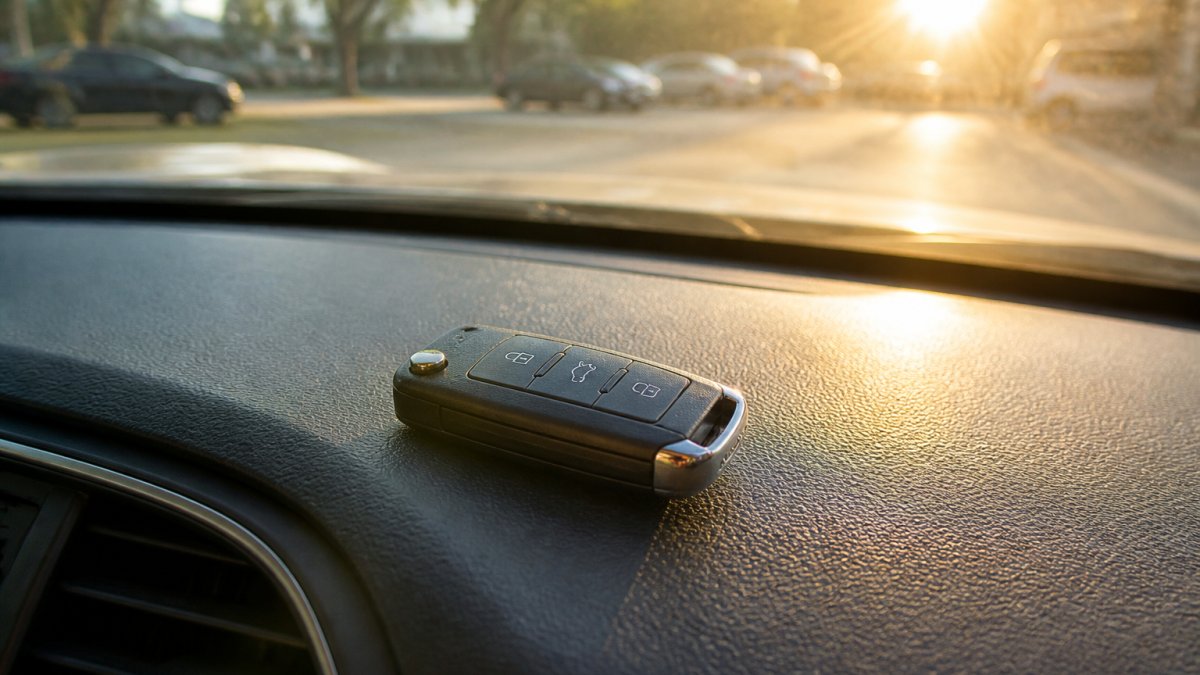
This is the mistake we see most often. A driver runs into a store, leaves the fob on the seat or in the cupholder, and comes back to a key that will not respond.
Here is why it happens. Plastic casing softens as it heats up. When it cools, it can crack or warp, which lets in humidity and dust.
Take your key with you. Every time. It is the simplest prevention method on this list, and it costs nothing.
3. Use a Protective Case or Silicone Cover
A protective case or silicone cover adds a layer of insulation between your key and the heat. It also absorbs impact and keeps dust and moisture out. But to pick the right one, it helps to understand what heat is actually doing to the fob's shell.
Most key fob casings are made from ABS plastic, polycarbonate, or a blend of the two. These materials are chosen for impact resistance and moldability, not for heat resistance.
That is why a cover helps, but only if it is the right kind. Look for a cover that:
- Fits snugly around the fob without blocking the buttons
- Uses silicone or a similar heat-resistant material
- Includes UV protection if you spend a lot of time outdoors
- Seals around the edges to keep humidity out
Silicone is a good choice because it tolerates high temperatures without losing flexibility, and it does not transfer heat as quickly as a hard shell. A rigid plastic or metal case protects against drops but can actually trap heat against the fob and reflect it back onto the casing.
Two caveats worth knowing:
- A cover slows heat transfer; it does not stop it. A fob left on a dashboard in full sun will still get hot enough to damage the battery and circuitry, cover or not.
- A cover that traps moisture is worse than no cover at all. If you notice condensation inside the case after a rainy day, dry the fob and the cover thoroughly before reassembling.
4. Check for Physical Damage Before It Gets Worse
Inspect your key fob every few weeks. Small cracks and loose buttons are early warning signs, and catching them early saves money.
Look for these problems:
- Cracks in the plastic casing, especially near the seams
- Buttons that feel loose, sticky, or slow to respond
- A fob that needs to be pressed harder or held closer to the car
- Discoloration or a sticky residue, which can signal battery leakage
Button responsiveness is a useful gauge. If you have to press twice or hold the button down, the internal contacts may already be worn or corroded.
Heat makes all of these worse. Thermal expansion and contraction push cracks wider over time. Humidity then gets inside and starts corrosion on the electronic components. A fob that still works but looks damaged is a fob that is about to fail.
5. Store Spare Keys in a Cool, Dry Location
Your spare key needs the same care as the one you carry.
The reason is humidity. Heat alone stresses the battery and the plastic casing, but heat combined with moisture is what kills the electronics.
A spare key stored in a garage or shed is exposed to that cycle every day. A spare stored inside a climate-controlled home is not.
Store spares:
- Inside your home, in a drawer away from windows
- In a cool, dry spot, not a garage or shed
- Away from direct sunlight and heat sources
- In a small sealed bag or case to keep humidity out
A resealable bag with a desiccant packet is a cheap upgrade. The desiccant absorbs moisture that would otherwise condense on the board. Replace the packet every few months, or when the indicator card (if the packet has one) changes color.
Also, do not store a spare key inside the car. It defeats the purpose, and it puts the key in the worst possible environment, the same hot, humid cabin that damages the fob you carry every day.
6. Replace Your Car Key Fob Battery Before It Fails
A car key fob battery replacement is cheap and quick. Waiting until the battery dies is what turns a small task into an emergency.
Most fobs use a lithium coin battery, often a CR2016 or similar size. Check your owner's manual or the back of the fob to confirm the correct type.
Signs it is time to replace the battery:
- The car responds only when you are standing right next to it
- The button on the fob lights up dimly or not at all
- You have to press a button more than once
- The fob is more than two years old
Heat speeds up battery capacity loss. A battery that would last three years in a mild climate may fail much sooner after repeated extreme heat exposure. Replace it on a schedule, not on a failure.
7. Know When to Call an Automotive Locksmith for a Car Lockout or Key Repair
Some problems are beyond a new battery. If your fob is cracked, water-damaged, or fully unresponsive, an automotive locksmith can often repair or replace it.
Call a professional when:
- The fob will not respond even with a fresh battery
- The casing is cracked or the buttons are stuck
- The key broke off in the ignition or door lock
- You are locked out and need emergency access
- The immobilizer system will not recognize the key
This is where SOUTHMIAMILOCKSMTIH.COM can help. Our technicians are licensed, bonded, and insured, and we work on both domestic and imported car keys. We handle emergency car lockouts and key repair across Miami-Dade County, and we use current diagnostic tools to get you back on the road.
A dealership visit is not always your only option. For many key repairs, an automotive locksmith can resolve the problem faster and with less hassle.
Quick Reference: Heat Damage Prevention at a Glance
| Problem | Prevention Step | Why It Works |
|---|---|---|
| Dashboard heat warps casing | Park in shade or garage | Cuts interior cabin temperature |
| Battery swells and leaks | Never leave fob in the car | Avoids extreme heat exposure |
| Cracks and dust get inside | Use a silicone cover | Adds insulation and a seal |
| Corrosion on contacts | Store spares cool and dry | Lowers humidity exposure |
| Sudden fob failure | Replace battery on schedule | Prevents a dead-key surprise |
| Broken or dead fob | Call an automotive locksmith | Repairs or replaces the key |
When Heat Damage Has Already Happened
Prevention is the goal, but heat damage does not always wait. If your key fob has already failed, you have options beyond a costly replacement.
For most drivers, a failing fob shows up as a car lockout or an ignition problem. Both can be handled by a qualified automotive locksmith. At SOUTHMIAMILOCKSMTIH.COM, we have spent over 30 years helping Miami-Dade drivers with emergency car lockouts, key repair, and car key fob battery replacement. Our licensed, bonded, and insured technicians work on domestic and imported keys, and we come to you when you are stranded.
Do not wait for a small crack to become a full lockout. Get started with SOUTHMIAMILOCKSMTIH.COM and keep your keys working through the hottest months of the year.
Frequently Asked Questions
Can extreme heat damage a car key fob battery?
Yes. High temperatures accelerate battery drainage and can cause lithium coin batteries like the CR2016 to leak or corrode. When a key fob sits in a hot car, interior cabin temperatures can exceed 140°F, which speeds up thermal degradation and shortens battery capacity. If your fob needs frequent car key fob battery replacement, heat exposure is often the cause. Store your fob in a cool place and replace the battery at the first sign of weak signal or delayed response.
What are the signs of a heat-damaged car key?
Common signs include reduced button responsiveness, a cracked or warped plastic casing, signal interference that makes the car slow to unlock, and visible corrosion around the battery contacts. You might also notice the immobilizer system failing to recognize the key. If your key fob stops working after being in direct sunlight, the internal circuitry or battery may already be compromised. An automotive locksmith can test the fob and confirm whether repair or replacement is needed.
Should I keep my key fob in a protective case during summer?
A protective case or silicone cover adds a layer of UV protection and reduces wear and tear on the plastic casing. It won't block heat entirely, but it helps prevent cracks and keeps dust and moisture away from the internal circuitry. Pair the case with shaded parking and never leave the fob on the dashboard. If humidity levels are high, a sealed case also limits corrosion on the battery contacts.
How do I know if my key fob needs a battery replacement or a full repair?
If the key still works when you press buttons directly against the car but fails from a distance, the battery is likely weak. If buttons feel stuck, the casing is cracked, or the car won't start even with a fresh battery, the internal circuitry or RF transmitter may be damaged. A car key repair cost depends on whether the issue is a simple battery swap or a full fob rebuild. A licensed locksmith can diagnose the problem quickly and give you an honest assessment.