 ultimate-guide
Emergency Automotive Locksmith Miami 2026: Full Guide
Table of Contents
- What an Emergency Automotive Locksmith in Miami Handles
- 24/7 Mobile Locksmith Response Time: What to Expect
- Car Key Replacement Cost: What Drives the Price
- How to Choose a Certified Automotive Locksmith
- Step-by-Step Emergency Protocol: What to Do First
- Insurance, Liability, and Damage-Free Entry
- Frequently Asked Questions
Last Updated: September 10, 2026
What an Emergency Automotive Locksmith in Miami Handles
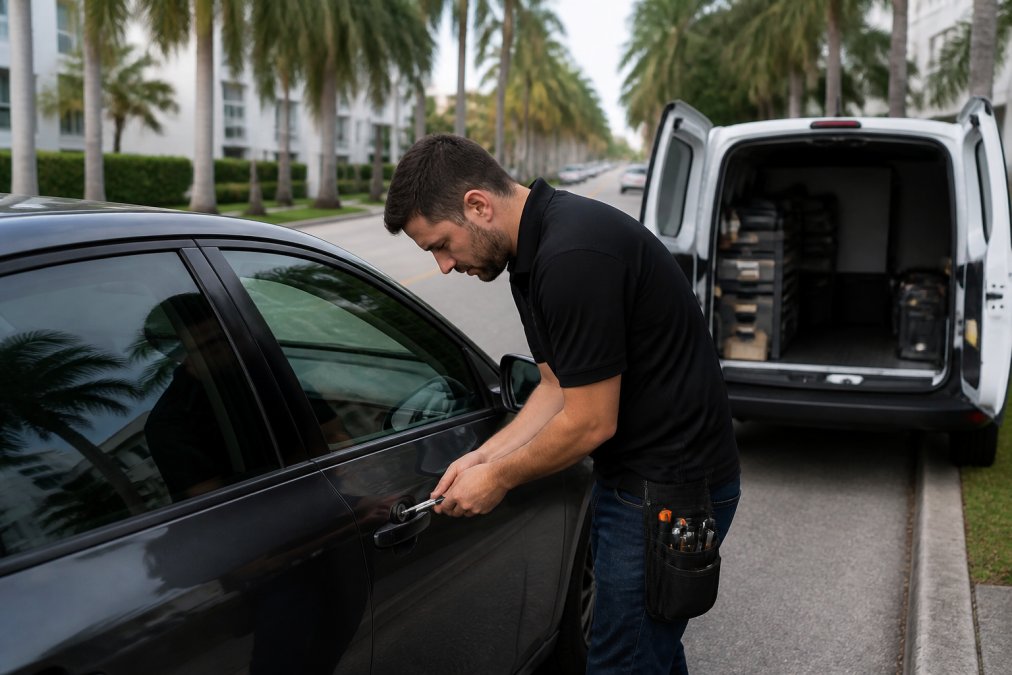
An emergency automotive locksmith miami handles vehicle lockouts, lost or broken keys, ignition failures, and trunk lockouts, usually arriving by mobile service rather than requiring you to tow the car. SOUTHMIAMILOCKSMTIH.COM has over 30 years of experience in the locksmith industry, and the pattern is consistent: most drivers call after dark, in a parking garage or on a street shoulder, with no idea what the job actually involves.
An automotive locksmith is a technician trained to open, repair, and replace vehicle locking and ignition systems without damaging the car. That distinction matters. A general handyman with a slim jim can pop an older door, but modern vehicles use transponder keys, immobilizer systems, and proximity fobs that require programming equipment and vehicle-specific software (nhtsa.gov).
Lockouts, Lost Keys, and Broken Ignitions
These three calls cover the vast majority of emergency work.
- Lockout recovery: Keys locked inside, or a fob that stopped communicating. A trained technician uses damage-free entry tools, not force.
- Lost or stolen keys: On-site key cutting and programming for chip keys, remote head keys, and laser-cut keys.
- Broken ignition: A key snapped off in the ignition switch, or a cylinder that no longer turns. This often needs key extraction before anything else.
A common mistake is trying to force a stuck key out with pliers. That usually pushes the broken half deeper into the ignition switch and turns a straightforward extraction into a full ignition repair.
24/7 Mobile Locksmith Response Time: What to Expect
Response time depends on your location, traffic, and the time of day, but mobile service means the technician comes to you rather than the reverse. A 24/7 locksmith dispatches a van stocked with cutting and programming equipment, so most jobs finish on site in a single visit.
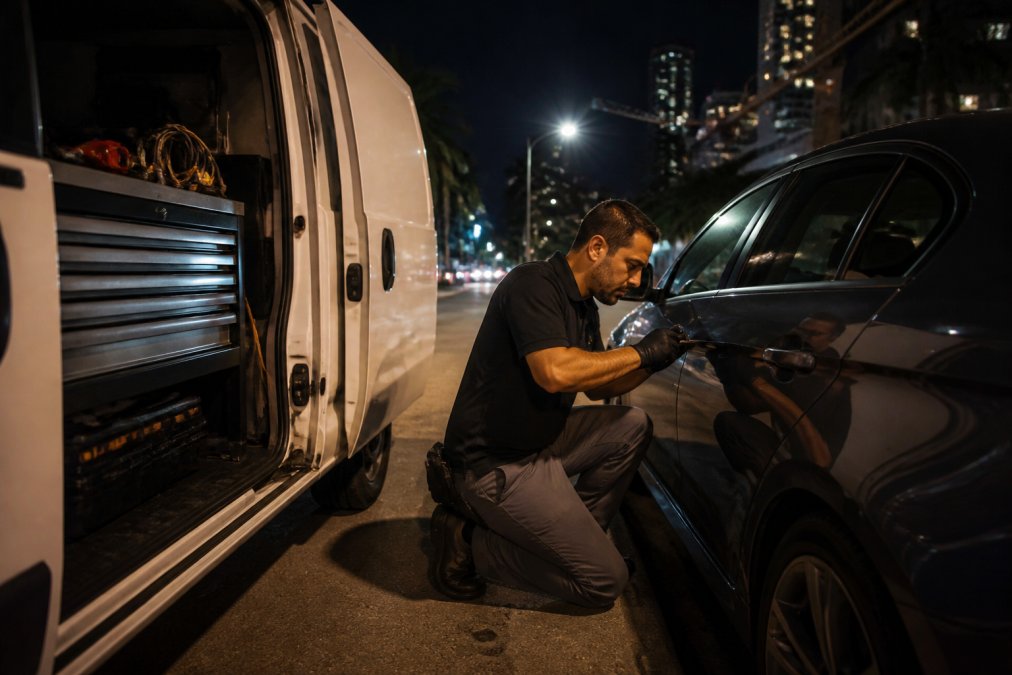
What slows a call down is rarely the driving. It's the vehicle. Older cars with mechanical locks take minutes. A late-model car with a proximity key and immobilizer system needs the technician to identify the correct blank, cut it, then program it to the vehicle's security module, which takes longer.
Vehicle-Specific Technology and How It Affects the Job
The single biggest variable in how long a call takes is the key and security system on your vehicle. Most practitioners group vehicles into four tiers, and the tier tells you more about the job than the make or model alone.
- Traditional mechanical key (typically pre-1990s and many base-model work trucks): No chip, no immobilizer. The technician picks or bypasses the door lock and cuts a replacement key on the spot. This is the fastest category.
- Transponder (chip) key (common from the mid-1990s through the 2000s): The key contains a passive chip the immobilizer reads before the engine will start. Cutting is only half the job; the key must be programmed to the vehicle's security module, which requires a scan tool or programmer connected to the OBD-II port.
- Remote head key and switchblade key: A single unit that combines the cut key and the remote buttons. If the remote half fails but the key still starts the car, some owners replace only the shell; if the chip or board is dead, the whole unit is typically replaced and reprogrammed.
- Proximity key / smart fob (push-button start, common on late-model vehicles): The fob communicates wirelessly with the vehicle, and the car may not have a physical ignition cylinder at all. Replacement requires pairing the fob to the security module, and on many models the vehicle must be present for the pairing to succeed.
Two practical consequences follow from this. First, a technician who mostly handles older mechanical-lock vehicles may not carry the software license or the correct blank for a late-model proximity system, which is why the second-trip problem exists. Second, the year, make, model, and trim matter more than the brand: two vehicles from the same manufacturer can use completely different key systems depending on trim and model year.
The practical takeaway: ask for an estimated arrival window when you call, and ask whether the technician carries the specific key blank and programming software for your vehicle. That single question separates a one-visit job from a two-visit one.
Car Key Replacement Cost: What Drives the Price
Car key replacement cost is driven by four factors: the type of key, whether the vehicle needs on-board programming, the time of day, and the service call fee. There is no single number, and any provider quoting one flat rate before seeing your vehicle is guessing.
The key type is the biggest variable. A basic mechanical key costs far less than a transponder key, which costs less than a proximity fob. The gap isn't arbitrary: each step up adds electronics, a unique chip, and programming time.
Transponder, Proximity, and Laser-Cut Keys
- Transponder key (chip key): Contains a chip the immobilizer system reads before allowing the engine to start. Cutting is only half the job; the key must be programmed.
- Proximity key / key fob: Communicates wirelessly with the vehicle. Replacement requires pairing the fob to the car's security module.
- Laser-cut key: Cut on the side rather than the edge, with tighter tolerances. Needs a dedicated cutting machine, not a hand file.
- Remote head key: A single unit combining the cut key and the remote buttons. If the remote half fails, the whole unit is usually replaced.
Why the Same Job Costs Different Amounts
Two drivers with the same model year can pay very different totals for what sounds like the same job. The reason is that the price is built from several stacked components, and each one can move independently.
- The key blank itself. A proximity fob is a manufactured electronic assembly, not a piece of cut metal. The blank cost alone can be several times a mechanical key, and some fobs are dealer-restricted, meaning the aftermarket supply is limited.
- Programming method. Some vehicles allow on-board programming with a sequence of steps the technician performs in the car. Others require a dedicated programmer connected to the OBD-II port, and a few require the security module to be accessed directly. The more the vehicle resists easy pairing, the more labor the job carries.
- All-keys-lost versus spare key. If you still have one working key, the technician can often clone or add a second key. If every key is gone, the vehicle may need to be unlocked, the immobilizer reset, and a new key programmed from scratch, a longer job with more steps.
- Time of day and day of week. A mobile locksmith charges for the trip, and that fee is typically higher outside standard hours. Late-night, weekend, and holiday calls carry a premium because the technician is working outside normal scheduling.
- Access difficulty. A car parked in a tight underground garage, on a steep driveway, or on a highway shoulder can add time and, in some cases, a second technician for safety.
The service call fee is the second factor drivers underestimate. Ask for the call-out fee and the key cost separately before you authorize work, and ask whether the quoted price includes programming or whether that is billed on top.
A transparent provider will break the total into its parts, service call, key or fob, cutting, and programming, and tell you which parts are fixed and which depend on what the technician finds on arrival. If a provider will only give one lump number, treat that as a signal about how the rest of the transaction will go.
How to Choose a Certified Automotive Locksmith
Choose a locksmith who is licensed, bonded, and insured, and who will confirm it before dispatching. Certification matters less as a certificate on a wall than as a filter: it tells you the technician has been vetted and carries coverage if something goes wrong.
The Federal Trade Commission publishes consumer guidance on avoiding locksmith scams, and the pattern it describes is worth knowing. Scams usually start with a low phone quote, then escalate on arrival. A legitimate provider gives you a name, a license or registration number, and a clear price before the van moves.
Licensing, Bonding, and Insurance Checks
Run these checks before you let anyone touch your vehicle:
- Ask for the technician's name and license or registration number
- Confirm the business carries liability insurance
- Ask whether the company is bonded
- Request the total price, including the service call fee, in writing or by text
- Confirm the business has a physical address, not just a phone number
- Ask what happens if the vehicle is damaged during entry
Bonding protects you if the technician commits theft or fraud. Liability insurance covers damage to your vehicle. These are different protections, and a provider should be able to explain both without hesitation.
The thing nobody tells you about this process is that the best time to research a locksmith is before you need one. Save a licensed provider's number in your phone now, while you're calm and can compare, rather than at 2 a.m. in a parking structure.
Step-by-Step Emergency Protocol: What to Do First
Work through these steps in order. Most drivers skip straight to calling, which is why they end up with whoever answers first rather than whoever is qualified.
- Get to safety. Move to the sidewalk or behind a barrier. If you're on a highway shoulder, stay out of traffic lanes.
- Confirm the problem. Is the key lost, locked inside, or broken in the lock? Each requires different equipment.
- Check for roadside assistance. Your auto insurance, auto club, or vehicle warranty may cover lockout service. Call them first; it costs nothing to ask.
- Document your vehicle. Write down the VIN, year, make, model, and trim. You'll need it for every quote.
- Call a licensed provider. Give them the vehicle details and your exact location, including the garage level or cross street.
- Get the price before work starts. Ask for the service call fee and the key or labor cost separately.
- Verify credentials on arrival. Ask to see identification and confirm the license number matches what you were told.
- Keep the receipt. You'll need it if you file an insurance claim or dispute a charge.
Insurance, Liability, and Damage-Free Entry
Damage-free entry is the standard a qualified technician works to, and it's also your best protection against a liability dispute. Modern opening tools reach the interior latch or actuator without bending the door frame, breaking glass, or damaging weather seals.
Ask two questions before work begins: does the company carry liability insurance, and what is their policy if the vehicle is damaged? A provider with real coverage answers both directly. One that deflects is telling you something.
Your own auto insurance may cover lockout service under roadside assistance, and some policies reimburse a locksmith call if you file a claim. Check your policy language before assuming you're paying out of pocket. For owners of imported vehicles, confirm the technician has experience with your make; key and immobilizer systems vary widely between domestic and imported models, and a technician who mostly handles one may not carry the right programming software for the other.
SOUTHMIAMILOCKSMTIH.COM's technicians are licensed, bonded, and insured, and the company has over 30 years of experience in the locksmith industry. They offer expertise in both domestic and imported car keys.
A lockout or a dead key fob never happens at a convenient time, and the difference between a fast, fairly priced automotive locksmith miami job and an expensive mess comes down to who you call. SOUTHMIAMILOCKSMTIH.COM provides prompt emergency locksmith services with licensed, bonded, and insured technicians, on-site key cutting and programming for both domestic and imported vehicles, and the equipment to handle transponder, proximity, and laser-cut keys. Save the number before you need it, and get a clear quote based on your VIN, year, make, and model.
Frequently Asked Questions
How much does an emergency car locksmith cost in Miami in 2026?
Pricing depends on the service, the vehicle's key technology, and the time of day. A simple lockout typically costs less than a transponder key replacement, and after-hours calls carry a service call fee. Because rates vary by provider and job, ask for a full quote before work begins. For current pricing, please contact SOUTHMIAMILOCKSMTIH.COM directly, and licensed providers should confirm the total upfront so there are no surprises.
What should I look for when hiring a licensed automotive locksmith?
Check three things: a current state license, proof of bonding and insurance, and a verifiable local address. Ask for the technician's name and license number before they arrive. A certified automotive locksmith will also ask you to prove ownership of the vehicle, such as a registration or ID, before unlocking it. That step protects you and confirms you are dealing with a legitimate, insured professional rather than an unlicensed operator.
How long does a mobile locksmith take to arrive for a car lockout?
Response time varies by location, traffic, and time of day. In dense Miami-Dade areas, a 24/7 mobile locksmith can often reach you within 20 to 45 minutes, while outlying areas may take longer. When you call, ask for an estimated arrival window and the technician's name. Confirm the service call fee and whether the quote changes after hours, so you know the total before anyone is dispatched.
Can an automotive locksmith replace a key fob on-site?
Yes. Mobile locksmiths carry programming equipment for transponder keys, remote head keys, and proximity fobs, so most replacements can be cut and programmed at your location. You will need to provide the vehicle's VIN, proof of ownership, and a valid ID. On-site service usually costs less than a dealership visit and avoids towing. Ask whether your specific make and model is supported before the technician arrives.