 how-to
Locksmith Car Lockout: What to Do Step by Step
Table of Contents
- What to Do the Moment You Realize You're Locked Out
- How Long Does a Car Lockout Take to Resolve
- Automotive Locksmith Tools Technicians Use to Open Your Car
- Car Lockout Services: What an Automotive Locksmith Actually Does
- Car Key Replacement Cost: What Affects Your Final Bill
- How to Verify a Mobile Locksmith Is Licensed and Legitimate
- How to Prevent Future Car Lockouts
- Conclusion
Last Updated: August 21, 2026
What to Do the Moment You Realize You're Locked Out
A locksmith car lockout is disorienting, but the first few minutes determine how smoothly the situation resolves. At SOUTHMIAMILOCKSMTIH.COM, we've responded to thousands of these calls over more than 30 years.
The most important thing: stay calm and stay safe. If you're in a parking garage, on a highway shoulder, or in an unfamiliar area at night, move to a well-lit, populated location before doing anything else.
Then work through these steps:
- Confirm the lockout by checking all four doors and the trunk.
- Check for a spare key with a family member, roommate, or trusted contact.
- Look up your roadside assistance coverage before calling a locksmith.
- Call a licensed automotive locksmith if no other option exists.
That last step matters. The locksmith you call in a panic has access to your vehicle. Vetting that call takes 60 seconds and can save you from a predatory situation.
Check Your Roadside Assistance and Insurance Coverage First
Many drivers don't realize they're already paying for car lockout coverage. Check these sources before spending anything out of pocket:
- Auto insurance policy: Many comprehensive policies include roadside assistance. Call the number on your insurance card and ask specifically about lockout service.
- Credit card benefits: Several major credit cards include roadside assistance as a cardholder benefit. Check your card's benefits portal or call the number on the back.
- Vehicle manufacturer programs: New and certified pre-owned vehicles often come with complimentary roadside assistance for a set period. Check your owner's manual or the manufacturer's website.
- AAA membership: If you're a member of the AAA roadside assistance program, lockout service is typically included in your membership tier.
If coverage exists, use it. The dispatch goes through a vetted network and the cost is either covered or capped.
DIY Attempts vs. Calling a Professional: The Real Risk
Most people make an expensive mistake by trying to open the car themselves. Modern vehicles are not designed to be opened without the right tools. The air gap between a car door and its frame is narrow, the weather stripping is fragile, and locking mechanisms on newer models are significantly more complex than they were a decade ago. A coat hanger or improvised wedge will not work on most vehicles built after 2010 and can trigger alarm systems or damage interior components.
DIY is only reasonable if you have a very old vehicle with manual locks and no electronic components. For anything else, the risk of damage outweighs the cost of a professional call.
How Long Does a Car Lockout Take to Resolve
How long a car lockout takes depends on response time and the complexity of the entry method required. A straightforward lockout on a standard vehicle typically takes a professional technician less than 10 minutes once they arrive on site.
Response time is the bigger variable. A mobile locksmith operating nearby can often arrive within 20 to 30 minutes. When you call, ask for a realistic arrival window rather than accepting a vague estimate.
More complex situations extend the timeline:
- Transponder key issues: If the key is inside but the car won't start due to a chip programming problem, the technician needs to diagnose that separately.
- Broken key in lock: Extraction takes additional time and specialized tools.
- High-security vehicles: Luxury vehicles with advanced locking systems require more time and specific equipment.
For most standard lockouts, plan for 30 to 45 minutes total from the time you call to the time you're back in your car.
Automotive Locksmith Tools Technicians Use to Open Your Car
Professional automotive locksmiths carry a specific set of tools that make non-destructive entry possible on modern vehicles. Understanding these tools helps you recognize a legitimate technician.
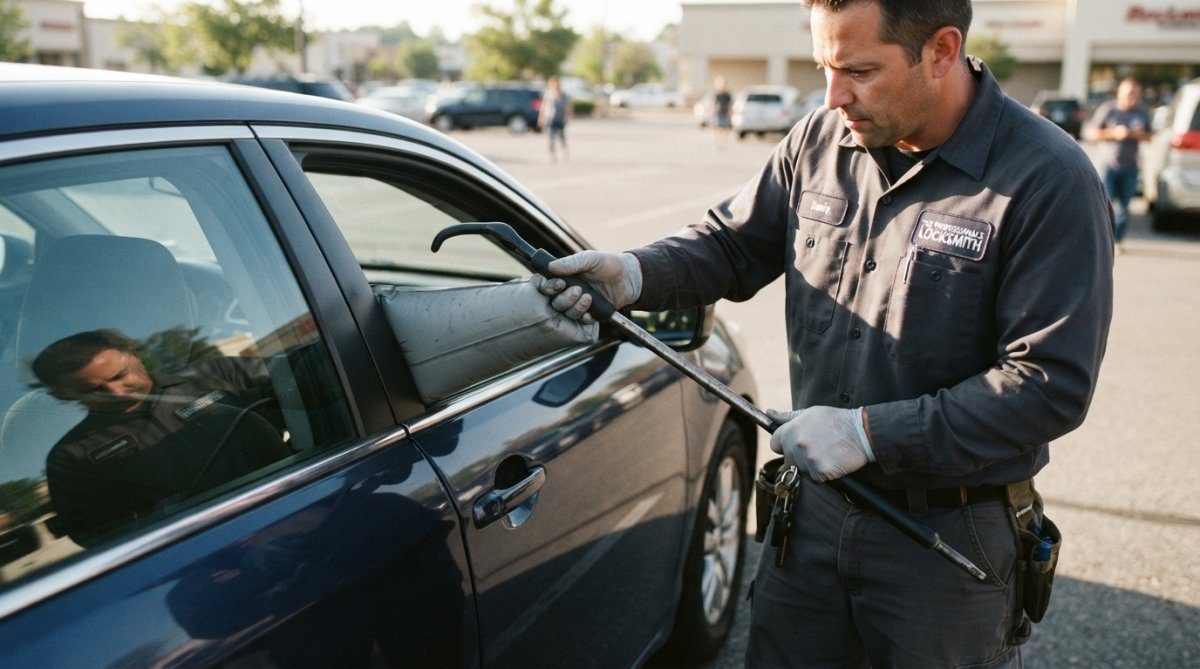
The core toolkit includes:
- Air pump wedge: Inserted at the top corner of the door frame to create a small gap without damaging the seal.
- Long reach tool: A flexible rod threaded through the gap to manipulate the interior door handle or lock button.
- J-tool and L-tool: Shaped rods used for specific vehicle door configurations, particularly on trucks and SUVs.
- Slim jim: A thin metal strip used on older vehicles with manual lock rods, though rarely applicable to modern cars.
- Key decoder and pick set: Used when the physical key needs to be cut or the lock cylinder needs to be manipulated directly.
Non-Destructive Entry Methods Explained
Non-destructive entry is the standard for any reputable automotive locksmith. The goal is to open the vehicle without leaving any trace of entry, preserving both the car's security and its resale value.
The most common method combines the air pump wedge with a long reach tool. The wedge creates a controlled gap at the door's upper corner, and the reach tool activates the interior unlock mechanism. Executed correctly, this leaves no damage to the door frame, weather stripping, or paint.
A legitimate technician will always attempt non-destructive entry first. If a locksmith immediately reaches for a crowbar or suggests breaking a window, stop and call someone else.
According to the Associated Locksmiths of America's professional standards, certified automotive locksmiths are trained specifically in non-destructive techniques and are expected to document their methods for each service call.
Car Lockout Services: What an Automotive Locksmith Actually Does
An automotive locksmith does considerably more than open a locked car door. The full scope covers emergency access, key replacement, ignition repair, and electronic programming.
This distinction matters because many drivers call a general locksmith for a car problem and get someone who only handles residential hardware. Automotive locksmith work requires specialized training, vehicle-specific knowledge, and equipment that general locksmiths often don't carry.
Transponder Key and Key Fob Programming
Modern vehicle keys contain a small electronic chip communicating with the car's immobilizer system. If the chip is absent, damaged, or not programmed to the vehicle, the car will not start even if the key turns the ignition.
Transponder key programming synchronizes a new or replacement key's chip to the vehicle's onboard computer. This requires access to the car's OBD-II port and specialized programming software that varies by make and model.
Key fob programming covers the remote functions like lock, unlock, and trunk release. Many vehicles allow basic fob programming through a sequence of door and ignition actions described in the owner's manual. Newer vehicles with rolling code security systems require professional programming equipment.
A qualified automotive locksmith carries the software and hardware to program both transponder keys and key fobs for many domestic and imported vehicles. The National Automotive Service Task Force's vehicle security resources maintains standards for how locksmiths access vehicle security data for legitimate programming work.
Ignition Repair, Replacement, and Broken Key Extraction
Ignition problems often surface during or after a lockout situation. A key that's been forced, worn down, or broken off inside the ignition cylinder creates a compounded problem: the car can't be started and the broken piece blocks any other key from being inserted.
Broken key extraction involves removing the fragment without damaging the ignition cylinder. Technicians use extraction hooks and spiral picks sized to the specific key type. In most cases, the cylinder can be preserved and a new key cut from the original key code on file.
Ignition repair addresses worn or damaged cylinders that no longer turn smoothly. A cylinder can sometimes be re-pinned to match a new key. When damage is severe, full ignition replacement is the appropriate solution.
A dealership replacement for an ignition or transponder key is often significantly more expensive than working with a qualified automotive locksmith. Get a quote from a locksmith before committing to a dealer service, particularly for vehicles outside the manufacturer's warranty period.
Car Key Replacement Cost: What Affects Your Final Bill
Car key replacement cost varies considerably depending on several factors. Understanding those factors helps you evaluate whether a quote is reasonable.
The main variables that affect cost:
| Factor | Impact on Cost |
|---|---|
| Key type (basic vs. transponder vs. smart key) | Higher complexity = higher cost |
| Vehicle make and model | Imported and luxury vehicles cost more |
| Programming requirements | Adds to labor time and equipment cost |
| Time of service (standard vs. emergency) | After-hours calls typically carry a premium |
| Whether the original key code is on file | Cuts without a code require additional work |
Basic mechanical keys for older vehicles without electronic components are the least expensive to replace. Transponder keys add programming labor. Smart keys and proximity fobs are the most complex and typically the most expensive.
For current pricing on any of these services, contact SOUTHMIAMILOCKSMTIH.COM directly for an accurate quote based on your specific vehicle and situation.
Cost Transparency: Questions to Ask Before You Agree to Anything
The locksmith industry has a documented problem with predatory pricing, particularly in emergency situations. The Federal Trade Commission's consumer guidance on home service scams specifically flags bait-and-switch pricing as a common complaint in the locksmith category.
Ask these questions before any work begins:
- What is the total cost, including labor, parts, and any service call fee? Get a complete number, not a starting price.
- Is there an after-hours or emergency surcharge? If yes, how much?
- Will you provide a written estimate before starting work? A legitimate technician will say yes.
- What happens if the job takes longer than expected? Understand whether the quote is fixed or hourly.
- Is the price different if I need programming in addition to entry? Sometimes a lockout call reveals a key programming need that adds cost.
If a technician arrives and immediately quotes a price significantly higher than what was stated on the phone, you have the right to refuse service and call someone else.
How to Verify a Mobile Locksmith Is Licensed and Legitimate
Verifying a mobile locksmith before they touch your vehicle takes less than two minutes.
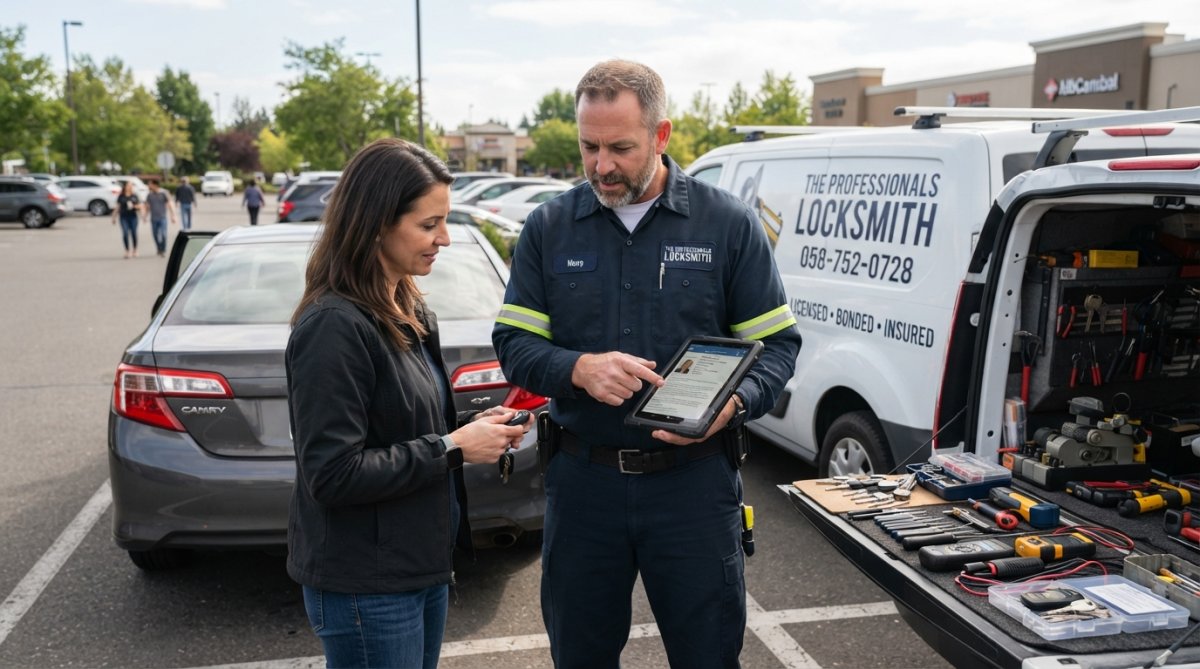
Start with these checks:
License verification: Most states require locksmiths to be licensed. You can verify a license number through your state's licensing board website. Ask the technician for their license number before they arrive and confirm it online.
Insurance and bonding: A legitimate locksmith is bonded and insured. Ask specifically: "Are you bonded and insured?" and ask for the carrier name if you want to verify.
Physical identification: When the technician arrives, ask to see their ID and company credentials. A professional will carry both and will not be offended by the request.
Vehicle and appearance: A legitimate mobile locksmith typically arrives in a marked vehicle with company branding. An unmarked personal vehicle warrants additional verification.
Online presence: Look up the company name and phone number before they arrive. Check for reviews, a legitimate website, and a physical business address. A phone number that only appears on a generic directory listing with no other web presence is a warning sign.
SOUTHMIAMILOCKSMTIH.COM's technicians are licensed, bonded, and insured, and carry credentials for verification on every call.
How to Prevent Future Car Lockouts
The best car lockout is the one that never happens. A few straightforward habits significantly reduce the likelihood of being locked out again.
Keep a spare key accessible. The most reliable prevention is having a spare key stored somewhere other than your vehicle or your primary key ring. A trusted family member or neighbor is the simplest solution.
Use a key tracker. Small Bluetooth trackers attached to your key ring let you locate your keys from your phone. They don't prevent a lockout if the keys are inside the car, but they eliminate the "where did I leave them" scenario.
Establish a consistent key habit. Most lockouts happen because of a break in routine. Putting your keys in the same place every time builds a habit that's hard to break.
Be aware of your key fob battery. A dead key fob battery can prevent remote unlocking. Replace the battery when the range starts to decrease rather than waiting for it to fail completely.
Know your backup access method. Most smart key vehicles have a hidden mechanical key inside the fob. Know where it is and how to use it before you need it.
A car lockout is stressful, but it doesn't have to become a costly or dangerous situation. The key is knowing what to do in the first few minutes, understanding what a legitimate automotive locksmith actually provides, and asking the right questions before any work begins. SOUTHMIAMILOCKSMTIH.COM brings over 30 years of experience, licensed and insured technicians, and expertise across domestic and imported vehicles to every call. Contact us for a transparent quote and fast response whenever a car lockout or key emergency occurs.
Frequently Asked Questions
How much does a locksmith charge to unlock a locked car?
Pricing for a car lockout service depends on several factors: time of day, your vehicle type, your location, and whether the job requires key cutting or programming in addition to entry. Emergency calls after hours typically cost more than daytime service. Always ask for a written quote before any work begins. Contact a licensed automotive locksmith directly for current rates rather than relying on estimates that may not reflect your specific situation.
Is it better to call a locksmith or roadside assistance for a lockout?
Roadside assistance through your auto insurance or a membership program can cover basic lockout calls at no extra charge, so check that first. However, roadside providers often dispatch third-party contractors with varying skill levels. A licensed automotive locksmith is the better choice when you need transponder key programming, broken key extraction, or ignition repair, since roadside programs rarely cover those services. For a simple lockout, either can work, verify coverage before you call.
Can a locksmith make a new car key on the spot?
Yes. A fully equipped mobile locksmith can cut and program a replacement key on-site for most domestic and imported vehicles. Chip keys, smart keys, and key fobs all require programming to the vehicle's onboard computer, which professional technicians handle with specialized diagnostic equipment. Laser key cutting is used for high-security key profiles. The process typically takes 30 to 60 minutes depending on the vehicle make, model, and key type.
How do I know a mobile locksmith is actually licensed and not a scam?
Ask for the technician's state license number before they begin any work. In most states, locksmiths must be licensed, bonded, and insured. You can verify a license through your state's licensing board. Legitimate companies provide a company name, physical address, and itemized written estimate before starting. Be cautious of anyone who arrives in an unmarked vehicle, refuses to show credentials, or quotes a very low price then dramatically increases it after gaining access to your car.
This article was written using GrandRanker