 how-to
Preventing Home Lockouts: A 2026 Miami Homeowner's Guide
Table of Contents
- Diagnostic Flowchart: Why Your Lock Is Failing
- Step 1: Identify the Cause of the Jam Before You Force Anything
- How to Maintain Door Locks to Prevent Home Lockouts
- Smart Lock Installation Benefits for Lockout Prevention
- Tools You Need for DIY Lock Repair
- Emergency Lockout Assistance: When to Call a Professional
- Weather-Specific Solutions for Preventing Home Lockouts
- Frequently Asked Questions
Last Updated: September 15, 2026
Diagnostic Flowchart: Why Your Lock Is Failing
Preventing home lockouts in Miami starts with one habit: diagnose before you force. The most common causes of a jammed residential lock are debris and corrosion in the keyway, misalignment between the door frame and strike plate, and worn internal components inside the cylinder. This guide from SOUTHMIAMILOCKSMTIH.COM covers each cause, the tools that fix it, and when to call a professional.
Here is the diagnostic sequence our technicians run on every service call:
- Does the key insert smoothly but refuse to turn? The problem is usually inside the cylinder, not the door.
- Does the key turn but the door stay shut? The latch bolt is not clearing the strike plate.
- Does the door handle feel loose or spin freely? The spring mechanism or internal components have failed.
- Does the lock only jam in humid or rainy weather? Swelling and corrosion are the likely culprits.
- Did the lock fail suddenly on a smart lock? Check the battery and keypad before anything else.
That logic saves money: forcing a stuck key or handle often turns a simple lubrication job into a full cylinder replacement.
Step 1: Identify the Cause of the Jam Before You Force Anything
Forcing a stuck lock is the most expensive DIY mistake. A key that will not turn under gentle pressure will not turn under heavy pressure either; it will snap, leaving half the key in the keyway and turning maintenance into an emergency lockout.
Start by testing the key with light, steady pressure in both directions. If it moves slightly but binds, the issue is friction or debris. If it does not move at all, something is mechanically blocking the cylinder. According to consumer safety guidance from the U.S. Federal Trade Commission, homeowners should verify any service provider's credentials before allowing access to their property, and the same caution applies to the tools and methods you use on your own hardware.
Debris and Corrosion in the Keyway
Debris is the leading cause of a stiff keyway, especially in coastal humidity. Dust, sand, and airborne salt mix with old lubricant to form a gritty paste that grips the tumblers. Corrosion follows the same path: moisture reaches the internal components, and the pins and springs bind.
The fix is straightforward. Blow out loose debris with compressed air, then apply a dry lubricant and work the key in and out several times to distribute it.
Misalignment Between the Door Frame and Strike Plate
Misalignment shows up as a door that latches only when you lift or push it. Humidity swells wood frames, and settling shifts the frame relative to the strike plate, so the latch bolt strikes the plate instead of sliding into it.
Check alignment by closing the door slowly and watching where the latch bolt meets the strike plate. A pencil mark on the plate shows exactly where the bolt is hitting. Adjusting the strike plate, or gently filing the opening, usually resolves it without touching the lock itself.
How to Maintain Door Locks to Prevent Home Lockouts
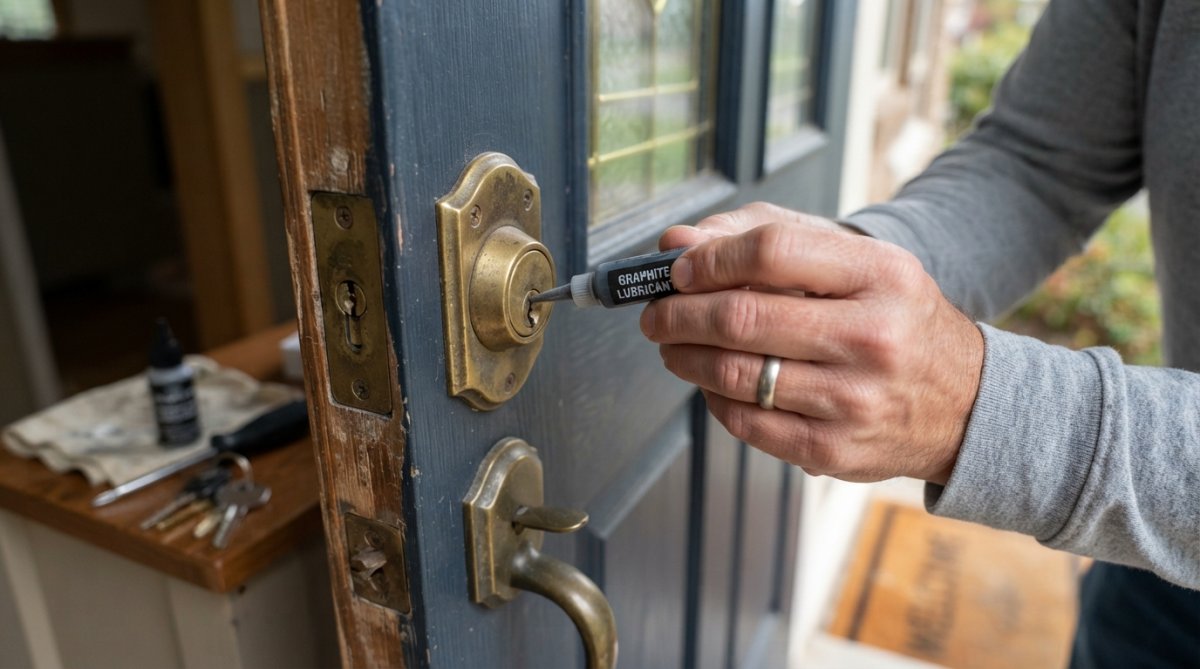
Regular maintenance is the cheapest lockout prevention available, and it takes minutes per lock. Cleaning and lubricating each lock twice a year keeps the cylinder, latch bolt, and spring mechanism working properly (nachi.org).
A practical maintenance checklist:
- Spray compressed air into the keyway to clear debris
- Apply a dry lubricant to the cylinder and work the key several times
- Tighten loose door knob and deadbolt screws
- Check that the door closes without lifting or pushing
- Test every key, including spares, on each lock
- Inspect exterior locks after heavy rain or a long dry spell
Graphite Powder vs. Silicone-Based Lubricant
Graphite powder and silicone-based lubricant both reduce friction but suit different situations. Graphite is a dry powder that works well in clean, low-humidity environments and will not attract dust. Silicone-based lubricant penetrates deeper and handles moisture better, which matters in humid coastal air.
The trade-off: graphite can clump if moisture gets into the keyway, and silicone can leave a residue that collects debris over time. For most homes, a light silicone-based lubricant applied sparingly twice a year is the safer default. Use graphite only where the lock stays dry.
Smart Lock Installation Benefits for Lockout Prevention
Smart lock installation benefits homeowners most in one way: it removes the key from the equation. Keypad entry, fingerprint access, and app-based unlocking eliminate the broken-key and lost-key lockout entirely. For condo residents and rental property managers, it also simplifies access control, issue and revoke codes between guests without rekeying anything.
The catch is that smart locks introduce their own failure modes. A dead battery locks you out just as effectively as a lost key, but it is rarely the only thing that can go wrong. Here is how to diagnose a smart lock that will not open, in order:
- Battery. Most models warn you with a low-battery alert days in advance, and many accept a 9-volt battery jump from terminals on the exterior housing as a backup. If the keypad is dark or unresponsive, this is almost always the cause.
- Keypad or fingerprint reader. A keypad that lights up but rejects every code usually means a dirty or worn touch surface, not a dead lock. Wipe it with a dry microfiber cloth; moisture and sunscreen residue are common culprits on exterior doors. Fingerprint readers fail the same way when the sensor glass is smudged.
- Motor or clutch. If the keypad accepts the code and beeps but the deadbolt does not move, the motor or clutch has failed. This is a hardware problem, not a battery problem, and it will not reset with a new battery.
- Firmware or app connectivity. A lock that works from the keypad but not the app is usually a network or firmware issue, not a lock issue. Check that the lock is still connected to your Wi-Fi or hub, and confirm the app is updated. A lock that dropped off the network after a router change is a common pattern.
- Mechanical binding. If the deadbolt moves partway and stops, the door frame or strike plate has shifted and the bolt is binding, the same misalignment problem a mechanical lock has, and the same fix.
A few habits prevent most smart lock lockouts:
- Keep the mechanical keyway fallback key somewhere other than inside the house.
Tools You Need for DIY Lock Repair
| Tool | What It Does | When You Need It |
|---|---|---|
| Compressed air | Clears debris from the keyway | Stiff or gritty key |
| Silicone-based lubricant | Reduces friction in the cylinder | Binding tumblers |
| Graphite powder | Dry lubrication for clean locks | Dry-climate maintenance |
| Screwdriver set | Tightens knobs, deadbolts, strike plates | Loose hardware |
| Needle-nose pliers | Straightens or removes bent keys | Key extraction |
| Metal file | Adjusts a strike plate opening | Misaligned latch bolt |
| Flashlight | Illuminates the keyway and plate | Every job |
Emergency Lockout Assistance: When to Call a Professional
Weather-Specific Solutions for Preventing Home Lockouts
Frequently Asked Questions
How do you unjam a door lock?
First, try turning the key gently while applying light pressure to the door to relieve binding on the latch bolt. If that fails, apply a silicone-based lubricant or graphite powder into the keyway and work the key back and forth. For a stuck latch bolt, remove the door knob and use a flathead screwdriver to retract the mechanism manually. If the cylinder or internal components are damaged, call a professional locksmith.
What causes a door lock to jam in humid climates?
High humidity causes corrosion inside the lock cylinder and tumbler, making internal components bind. Moisture also causes wood door frames to swell, misaligning the door with the strike plate. In coastal areas, salt in the air accelerates rust on metal hardware. Regular lubrication with a silicone-based lubricant and checking door alignment every few months prevents most humidity-related jams.
How does regular lock maintenance prevent emergency lockouts?
Regular maintenance removes debris from the keyway, keeps the spring mechanism moving freely, and catches misalignment before it locks you out. A yearly check of all exterior door locks, including the deadbolt and door knob, takes under 30 minutes. If you notice the key sticking or the latch bolt not retracting smoothly, address it immediately rather than waiting for a full mechanical failure.
When should you call a professional locksmith for a jammed lock?
Call a locksmith when the key breaks off inside the cylinder, when the latch bolt won't retract after removing the knob, or when the deadbolt is stuck in the extended position. If you've tried lubrication and alignment adjustments without success, forcing the lock further can damage the cylinder and door frame. A licensed technician can extract broken keys and repair internal components without replacing the entire lock.