 how-to
How to Verify Licensed Locksmiths in Miami: 7 Steps
Table of Contents
- What You'll Need to Verify a Locksmith in Miami
- Step 1: Look Up the License in Florida's State Database
- Step 2: Confirm Insurance and Bonding Before Work Begins
- Step 3: Check Complaint Records with Consumer Protection Agencies
- Step 4: How to Spot a Locksmith Scam Before You Pay
- Step 5: Verify Credentials on Site: Visual Identification and Documentation
- Emergency vs. Non-Emergency: How Verification Changes When You're Locked Out
- Step 6: Ask the Right Questions and Get a Written Estimate
- Frequently Asked Questions
Last Updated: September 12, 2026
What You'll Need to Verify a Locksmith in Miami
To verify licensed locksmiths in Miami, you check a state license, confirm insurance and bonding, and match the technician at your door to the name on the paperwork. At SOUTHMIAMILOCKSMTIH.COM, our technicians carry that documentation on every call.
Below is the exact verification sequence, from the state database lookup to the questions you ask before anyone touches your door.
Step 1: Look Up the License in Florida's State Database
Every legitimate locksmith in Florida holds a state-issued license searchable in a public database. The lookup takes under two minutes and is the highest-value check you can run.
What Florida Requires of Locksmiths
Locksmith work in Florida falls under the state's contractor licensing framework, which requires a license, a background check, and proof of insurance before a technician can legally operate (myfloridalicense.com). Requirements are set by the state, not by the individual company, so any provider claiming to be "locally certified" without a state license number is describing something that doesn't exist. The Florida Department of Business and Professional Regulation licensing portal is where those records live.
How to Search the State Licensing Database
- Open the state licensing database and select the license type search
- Enter the company name or the license number the provider gave you
- Confirm the status reads active, not expired or revoked
- Match the business name on the record to the name on the estimate
- Screenshot the result and save it before work begins
A license number that returns no record, or a record under a different company name, ends the conversation.
Step 2: Confirm Insurance and Bonding Before Work Begins
Insurance and bonding protect you if a technician damages your door, breaks a lock, or causes injury. Ask for the certificate before work starts.
Why General Liability Insurance Matters for Lock Work
Drilling, prying, and cylinder replacement can damage a door, frame, or finished surface. General liability insurance covers that damage; without it, you're negotiating repairs directly with the technician, usually in small claims court.
How to Request Proof of Bonding and Coverage
Ask the dispatcher to email a certificate of insurance and a surety bond document before the technician arrives. The certificate should name the business, list an active policy period, and include the insurer's contact information. Call the insurer to confirm the policy is current.
Step 3: Check Complaint Records with Consumer Protection Agencies
A license lookup tells you a company exists on paper; complaint history tells you how it behaves when a job goes wrong. Run these checks in order, and budget about ten minutes.
1. Disciplinary Actions in the State Licensing Database
Open the Florida Department of Business and Professional Regulation license search and pull up the license record again. On the detail page, look for a disciplinary history or complaint section. What you're scanning for:
- Administrative complaints filed against the license
- Citations, fines, or probation attached to the license
- Suspensions or revocations, including any that were later reinstated
- Cease and desist orders naming the business or its owners
A single closed complaint from several years ago with no follow-up is not disqualifying. An active case, a pattern of citations, or a revocation that was reinstated within the last year is.
2. State Attorney General Consumer Complaint Records
The state attorney general's office maintains a consumer complaint database and publishes enforcement actions against businesses with repeated complaints. Search the business name, every DBA, and the owner's name on the license record. Pay attention to complaints describing a quote that changed at the door, a demand for cash, or work by someone other than the licensed contractor.
3. Better Business Bureau and Local Consumer Affairs
The Better Business Bureau profile shows complaint volume, whether the business responded, and how complaints were resolved. Also check your county's consumer protection office, which sometimes has records the state does not.
4. What a Complaint Pattern Actually Looks Like
Three signals should end your search immediately:
- A cluster of complaints about pricing that changed after the technician arrived
- Complaints describing a demand for cash with no receipt
- Complaints that name a different business than the one you called, a strong indicator of a lead-generation operation routing calls to whoever answers
5. How to File a Complaint If Something Goes Wrong
If you've been overcharged, had work done by an unlicensed provider, or been threatened with a lien over a disputed bill, file in writing with all three:
- The state licensing board, file through the DBPR complaint portal with the license number, invoice, date of service, and any photographs of the technician, vehicle, or license card.
- The state attorney general's consumer protection division, file online or by mail with the same documentation. This office pursues patterns of fraud across multiple consumers.
- Your county consumer protection office, file locally too; local agencies sometimes act faster on a single complaint than the state does.
Keep copies of everything. A complaint with a license number, invoice, and photograph is far more actionable than one that says only "they overcharged me."
Step 4: How to Spot a Locksmith Scam Before You Pay
Scam locksmith operations follow a recognizable script designed to keep you from verifying anything until the bill is written.
Red Flags: Unmarked Vehicles, No ID, and Cash-Only Demands
- An unmarked vehicle with no company branding or license number
- A technician who can't produce a photo ID or license card on request
- A price quoted on the phone that changes substantially once you're locked out
- A demand for cash only, with no card option and no receipt offered
- A drill-first approach with no attempt at non-destructive entry
- A phone number that routes to a call center rather than a local dispatcher
What a Legitimate Service Call Should Include
A professional call starts with a written estimate, includes a uniformed technician in a marked vehicle, and ends with an itemized invoice and a work order number you can use to dispute a charge later.
Step 5: Verify Credentials on Site: Visual Identification and Documentation
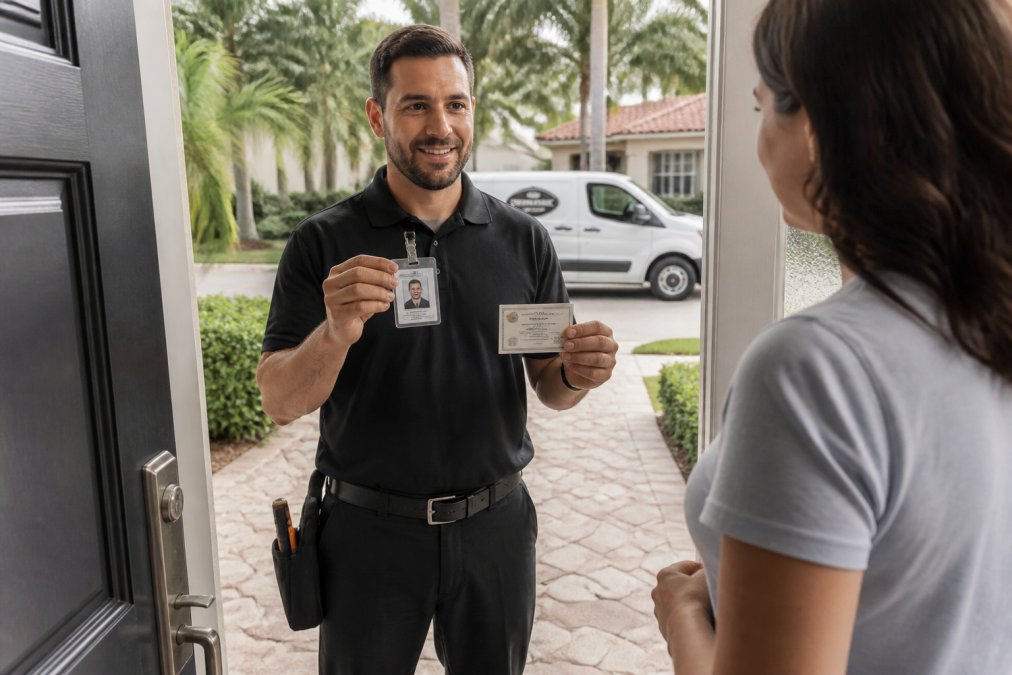
On-site verification is the last checkpoint and takes about sixty seconds. A legitimate technician expects it and hands over documentation without being asked twice.
What a Valid State License Card Should Show
A state-issued license card is a physical credential, not a screenshot on a phone. When the technician hands it over, confirm these fields are present and legible:
- The license holder's name, this should match the name on your written estimate and the name that came up in the state database lookup
- The license number, the same number you searched, digit for digit
- The license type or classification, the category of work the holder is authorized to perform
- The expiration date, an expired card is not a valid credential, regardless of what the technician says about renewal
- The issuing state agency's name, the card should identify the agency that issued it
- A photograph of the license holder, compare the photo to the person standing in front of you
A laminated photocopy, a business card with a number written on it, or a phone photo of a card is not the same thing. Ask to hold the physical card.
The Three Documents to Ask For
Ask to see three things, in this order:
- Photo identification, a driver's license or state ID. Match the name to the license card and the estimate.
- The state license card, verify the number against the lookup you already ran. If you haven't run it yet, run it now, on your phone, before any work begins.
- The certificate of insurance, if you didn't receive it by email, ask for a copy now. The certificate should name the business, list an active policy period, and include the insurer's phone number.
Then step outside and check the vehicle. It should carry the company name and, usually, the license number. An unmarked vehicle is a red flag even if the paperwork checks out.
What to Do If the Credentials Don't Match
If the name on the card doesn't match the estimate, the license number returns no record, or the technician can't produce a physical card, stop the job before any work begins. Ask the technician to leave, call the company, and cancel the service call. If you've paid a deposit, dispute it in writing with your card issuer or bank.
Emergency vs. Non-Emergency: How Verification Changes When You're Locked Out
Verification doesn't get skipped in an emergency, but the sequence compresses. Locked out at 2 AM, shift the real-time checks to the front.
Run these before you give an address:
- Search the license number the dispatcher gives you while you're still on the phone
- Ask for the total price, including the service call fee, before you confirm
- Confirm the technician will carry photo ID and a license card
- Ask whether payment can be made by card
For a planned job like rekeying a rental unit or installing a master key system, run the full sequence in advance: license lookup, insurance certificate by email, complaint history, and a written estimate. Emergency work compresses the timeline, not the standard.
Step 6: Ask the Right Questions and Get a Written Estimate
A written estimate before work begins is your strongest protection against a bill that doubles at the door. Get it in writing, even by text, and confirm the total before the technician starts.
Ask these questions on the call:
| Question | What a Good Answer Looks Like | What Should Concern You |
|---|---|---|
| What's your license number? | A number you can verify in the state database | A refusal or a vague "we're licensed" |
| Is there a service call fee? | A stated fee, disclosed upfront | "We'll tell you when we arrive" |
| What's the total, including parts? | A written estimate before work | A price that only appears on the invoice |
| Are you insured and bonded? | A certificate emailed on request | "Don't worry about that" |
| How do you take payment? | Card, cash, or check with a receipt | Cash only, no receipt |
| Will I get a written invoice? | An itemized invoice with a work order number | No paperwork offered |
If you've been overcharged or had work done by an unlicensed provider, file a complaint with the state licensing board and your state attorney general's consumer protection division. Include the license number, the invoice, and any photographs.
Getting locked out is stressful enough without wondering whether the person at your door is legitimate. SOUTHMIAMILOCKSMTIH.COM has served the Miami area for over 30 years with licensed, bonded, and insured technicians who carry their credentials on every call, including certified expertise in Medeco and Multlock high-security locks. Whether you need emergency lockout service, a rekey for a rental unit, or a commercial access control system, you get a written estimate and an itemized invoice. Get started with SOUTHMIAMILOCKSMTIH.COM and hand your keys to a technician you've already verified.
Frequently Asked Questions
Do locksmiths need a license in Florida?
Yes. Florida requires locksmiths to hold a state license. Licensed locksmiths must pass a background check, carry liability insurance, and display their license number on service vehicles and invoices. You can verify any license through the state licensing database before hiring. If a locksmith cannot provide a license number or claims licensing is not required, treat it as a red flag and look elsewhere.
How can I verify a locksmith's license number?
Ask the locksmith for their license number and the name of the licensing agency. Then search that number in the state licensing database online or call the agency directly. A legitimate licensed locksmith will provide this information without hesitation. Cross-check the name on the license against the technician who arrives and the company on the service vehicle. If any details do not match, do not proceed with the job.
What should I look for when hiring a locksmith?
Start with a valid state license, proof of liability insurance and bonding, and a physical business address. Ask for a written estimate before work begins and confirm the total price in writing. A trustworthy locksmith arrives in a marked vehicle, wears a uniform, carries identification, and provides a written invoice after the job. Check complaint records with consumer protection agencies and the Better Business Bureau. Avoid any locksmith who demands cash only or pressures you into immediate payment.
How do I report an unlicensed locksmith?
Report unlicensed locksmiths to the appropriate state licensing board. You can also file a complaint with the Florida Attorney General's office and your local consumer protection agency. Gather the locksmith's name, vehicle description, license plate number, and any receipts or messages. If you were overcharged or threatened, contact local law enforcement. Reporting helps protect other consumers and supports scam prevention efforts in your community.