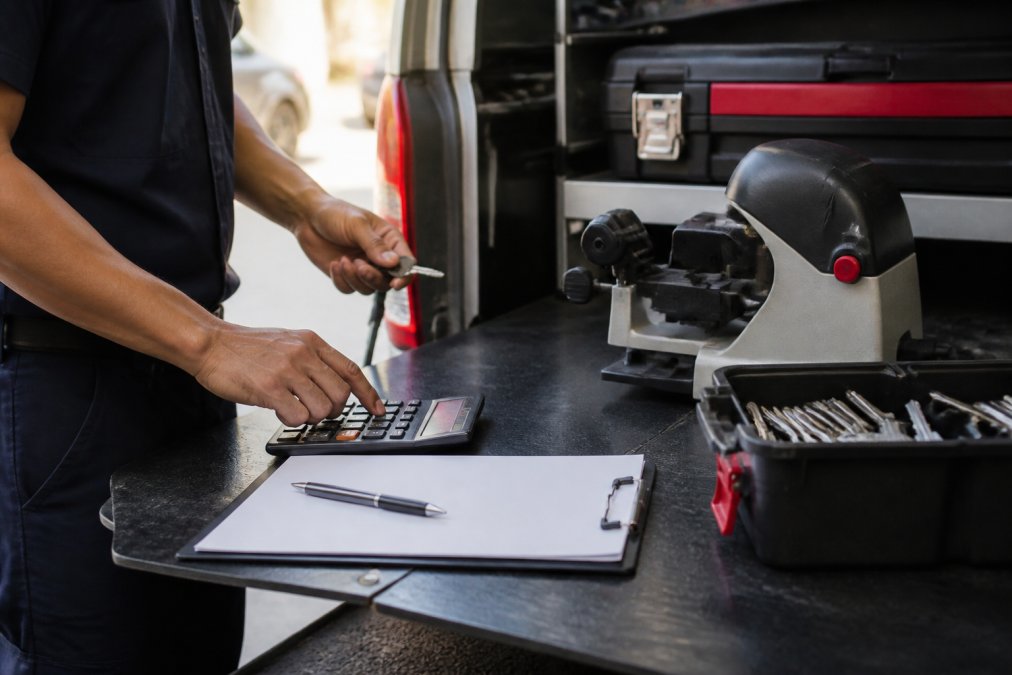
 how-to
Mobile Locksmith Costs: Average Prices in 2026
Table of Contents
- How Mobile Locksmith Pricing Works
- Locksmith Call-Out Fee Breakdown: What You're Actually Paying For
- Factors Affecting Locksmith Labor Costs
- Common Mobile Locksmith Services and What Drives Their Cost
- How to Identify a Licensed Locksmith Before You Pay
- Insurance, Warranty, and DIY vs. Professional Decisions
- Conclusion: Getting a Fair Price on Mobile Locksmith Costs
- Frequently Asked Questions
Last Updated: September 24, 2026
How Mobile Locksmith Pricing Works
Mobile locksmith costs depend on the job, the time of day, and the provider. Most companies charge a service call fee plus labor, then add parts or after-hours fees.
Mobile locksmith costs usually break into four parts:
- A service call fee or trip charge
- An hourly or flat labor rate
- Parts, like keys, cylinders, or lock hardware
- Surcharges for nights, weekends, and holidays
Flat Rates vs. Hourly Rates
Flat rates are safer for most customers: you agree on a total price before work starts, which suits a simple car or home lockout.
Why Quotes Vary by Provider
Two companies can quote very different prices for the same lockout, usually because of overhead, not skill. A company with a real office, insured techs, and vans costs more to run than a one-person operation.
Locksmith Call-Out Fee Breakdown: What You're Actually Paying For
A service call fee is the base charge for sending a technician to your location. It covers travel and showing up, applies even if you cancel after the tech arrives, and is the fee people most often confuse with the full price.
Service Call Fee vs. Trip Charge vs. Minimum Labor
These three terms get used interchangeably, but knowing the difference helps you avoid a bait-and-switch quote.
- Trip charge / service call fee: A flat fee for the drive, whether or not any work is done. Typical range is $15 to $50 in most metro areas, higher in rural zones.
- Minimum labor: A one-hour minimum that kicks in the moment the tech starts working, even if the job takes ten minutes. A $35 trip charge plus a $75 one-hour minimum is a $110 floor before parts.
- Hourly labor beyond the minimum: Billed in 15- or 30-minute increments after the first hour. This is where a "simple" re-key can balloon if the tech works slowly.
What the Trip Charge Actually Covers
The trip charge is not pure profit. It covers fuel, vehicle wear, insurance, dispatch overhead, and the tech's unpaid drive time. In dense urban areas a 15-minute drive is cheap to absorb; in a spread-out metro or rural county, a 45-minute drive each way can eat most of a $35 trip charge, which is why rural quotes run higher.
How Surcharges Stack on Top
After the trip charge and labor, surcharges layer on. They are rarely volunteered on the phone.
| Surcharge Type | Typical Trigger | How It Is Billed |
|---|---|---|
| After-hours | Before 8 AM or after 6 PM | Flat add-on, often $25-$75 |
| Weekend | Saturday or Sunday | Flat add-on or higher hourly rate |
| Holiday | Major federal holidays | Highest tier, sometimes double the base |
| Emergency / priority | Same-day or under-1-hour response | Percentage of the total or flat fee |
| High-security lock | Medeco, Multlock, restricted keyway | Higher labor rate, not a surcharge per se |
The Questions That Force a Real Quote
Before you agree to anything, ask these five questions. A legitimate dispatcher will answer all of them without hesitation.
- What is the trip charge, and is it credited toward the job if I proceed?
- What is the minimum labor charge, and how is time billed after that?
- What is the after-hours or weekend surcharge, if any?
- What is the all-in price range for my specific job, given the time I am calling?
- Is there a written estimate, and will the tech honor it if the job is what I described?
Factors Affecting Locksmith Labor Costs
Several things push locksmith labor costs up or down. Knowing them helps you predict a quote before you call.
- Lock type: A standard key lock is quick to open. High-security locks take longer.
- Job complexity: A simple lockout is fast. An ignition cylinder repair is not.
- Time of day: After-hours work always costs more.
- Location: Distance adds to the trip charge.
- Parts needed: A new smart lock or transponder key adds real cost.
Common Mobile Locksmith Services and What Drives Their Cost
Different services carry very different price drivers. A lockout is mostly labor. A key replacement is mostly parts and programming.
Residential Lockouts and Re-Keying
A home lockout is usually the cheapest call. The tech opens the door, and you are done. Re-keying costs more because the tech changes the internal pins so old keys stop working. Many new residents re-key for safety.
Automotive Key and Ignition Services
Car work costs more than home work. A transponder key or key fob programming needs special equipment. An ignition cylinder replacement takes time and skill. Dealerships often charge far more than a mobile provider for the same job.
Commercial and Safe Services
Commercial jobs include master key systems and access control, which take planning and cost more. Safe work, like opening a safe with a lost combination, is a specialty service.
How to Identify a Licensed Locksmith Before You Pay
You can check a locksmith's credentials before you let them in. Ask for their license number, proof of insurance, and a written estimate. A real company will share all three without hesitation.
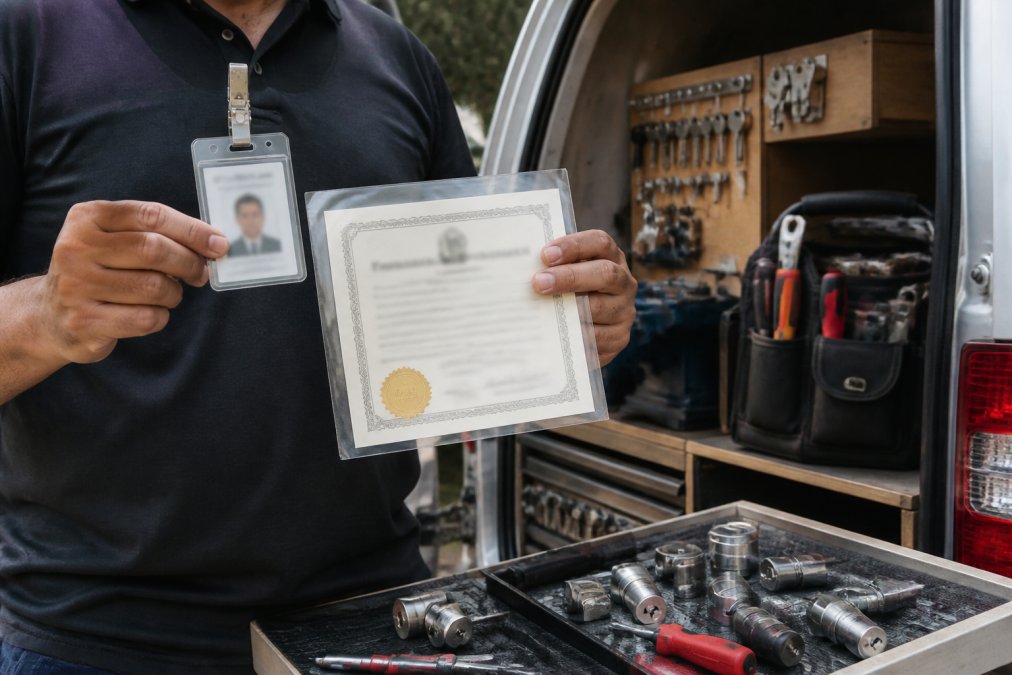
Watch for these red flags:
- No physical address or business license
- A quote that jumps once the tech arrives
- Cash-only demands with no receipt
- A van with no company branding or markings
- Pressure to replace a lock that could be repaired
Insurance, Warranty, and DIY vs. Professional Decisions
Whether insurance pays, whether a warranty covers the part, and whether you should touch the lock yourself are three separate questions with three separate answers.
Does Insurance Cover a Locksmith Call?
For a simple lockout, the answer is almost always no. Most homeowners policies treat a lockout as maintenance, not a covered loss, and auto policies are the same: a lost key or lockout is a convenience problem, not a claim. Filing one is usually not worth the deductible, and some insurers treat repeated small claims as a risk flag.
There are exceptions worth knowing:
- Homeowners and renters insurance: A lockout that follows a covered event, a break-in, a fire, a storm that damages a door, may be covered under the dwelling or personal property portion of the policy. The locksmith cost is part of the repair, not a standalone claim.
- Auto insurance: Comprehensive coverage may pay for a key replacement or lock repair if the loss is tied to theft, vandalism, or a covered incident. A plain lost key is not a covered loss under most policies.
- Roadside assistance and auto clubs: This is the most reliable path. Many auto club memberships and credit-card roadside programs include lockout service as a benefit, often with a per-incident cap. Check your card benefits before you call a locksmith, the service may already be paid for.
- Renters insurance: Some policies include a small lockout or re-key benefit after a break-in. Read the loss-of-use and additional-coverage sections, not just the main policy.
Warranty Coverage: What Is Actually Covered
Warranty coverage is different from insurance. It applies when a part fails because of a defect, not because you lost a key.
- Lock hardware warranties: Most major lock brands warranty the mechanical parts for the life of the product, but labor is almost never included. If a deadbolt fails, the maker may ship a replacement cylinder; you still pay a locksmith to install it.
- Smart lock warranties: Typically one to three years on electronics. The warranty usually covers the device, not the installation or the re-keying of the door.
- Automotive key and fob warranties: New-vehicle warranties often cover a defective key or fob, but not a lost one. A lost key is on you.
- Workmanship warranties: A legitimate locksmith should warranty their own labor for a set period, often 30 to 90 days. Ask for it in writing. If the lock fails after service, this is what covers the fix.
DIY vs. Professional: A Decision Checklist
Some jobs are genuinely DIY. Others will cost you more if you try. Use this checklist before you decide.
Safe to DIY:
- Key duplication: A standard key can be copied at a hardware store or big-box retailer for a few dollars. Skip this for transponder, laser-cut, or restricted keys, those need a locksmith or dealer.
- Smart lock installation: Most consumer smart locks are designed for a standard deadbolt opening and include a screwdriver-level install guide. If your door has a standard 2-3/8" or 2-3/4" backset, this is a weekend job.
- Battery and app resets: A smart lock that stops responding is often a dead battery or a firmware issue. Check the app and the batteries before you call anyone.
- Spare key retrieval: A hidden spare or a key with a neighbor solves most lockouts for free. This is the single highest-value habit in this entire article.
Call a professional:
- Lock picking and lockout entry: Picking requires feel and practice. A wrong move can bend a pick off inside the cylinder or scratch the plug, turning a $95 lockout into a $200 cylinder replacement.
- Key extraction: A broken key in a lock needs extraction tools. Pliers and a prayer usually push the fragment deeper.
- Ignition and transponder work: Modern ignitions are tied to the vehicle's immobilizer. A wrong key or a botched programming attempt can lock the system and require a dealer visit.
- Re-keying: Re-pinning a cylinder requires the right pin kit and a follower. It is not hard for a pro and not worth learning on your only door.
- High-security locks: Medeco, Multlock, and similar restricted-keyway systems are designed to resist picking. Forcing them damages the cylinder.
- Safe opening: Safe work is a specialty. Drilling a safe open destroys it; a pro opens it intact.
Why the Pro Premium Is Usually Worth It
A licensed provider warranties their work: if the lock fails after service, they fix it. A DIY repair gives you no such protection, and a damaged cylinder or immobilizer can cost several times the original service call to correct.
Conclusion: Getting a Fair Price on Mobile Locksmith Costs
The biggest challenge with mobile locksmith costs is that quotes are hard to compare. One company bundles everything into a flat rate. Another splits it into a call-out fee, labor, and surcharges. That makes an honest quote look higher than a misleading one.
Frequently Asked Questions
Are mobile locksmiths more expensive than storefront locations?
Mobile locksmiths often charge similar labor rates to storefront shops but add a service call fee or trip charge to cover travel to your location. The convenience of on-site service can make the total bill slightly higher, but you save time and towing costs. For emergency lockouts, a mobile locksmith is usually the only practical option. Always ask for a full quote including the trip charge before agreeing to service.
What is the average call-out fee for a locksmith?
A locksmith call-out fee, also called a service call fee or trip charge, covers the technician's travel and initial assessment. After-hours, weekend, and holiday calls often add a surcharge. This fee covers the technician's travel and initial assessment, not the actual lock work. Some providers waive the call-out fee if you proceed with the repair or replacement they recommend.
How do locksmiths calculate labor costs?
Most locksmiths calculate labor costs using either a flat rate per job or an hourly rate. Flat rates are common for standard tasks like lockouts or re-keying, while hourly rates apply to complex installations or diagnostics. Factors affecting locksmith labor costs include job complexity, lock type, time of day, and whether high-security hardware is involved. Ask whether the quoted price includes labor and parts or if those are billed separately.
How can I verify if a locksmith is licensed and insured?
To identify a licensed locksmith, ask for their state or local license number and proof of insurance before work begins. Locksmiths must carry a license and be bonded. You can also check with your state's consumer protection office or locksmith licensing board. A legitimate technician will provide credentials without hesitation and may carry certification in high-security brands like Medeco or Multlock.