 blog
blog
5 Best Ways to Secure Your Home in Miami (2026 Guide)
Table of Contents
- 1. Reinforce Entry Points With High-Security Deadbolt Installation
- 2. Upgrade to Smart Locks: Key Smart Lock Benefits for Miami Homes
- 3. Build a Layered Perimeter With Lighting and Cameras
- 4. Harden Against Storms and Fire Hazards
- 5. Schedule Professional Residential Locksmith Services
- How the Best Ways to Secure Your Home in Miami Work Together
- Frequently Asked Questions
Last Updated: September 30, 2026
1. Reinforce Entry Points With High-Security Deadbolt Installation
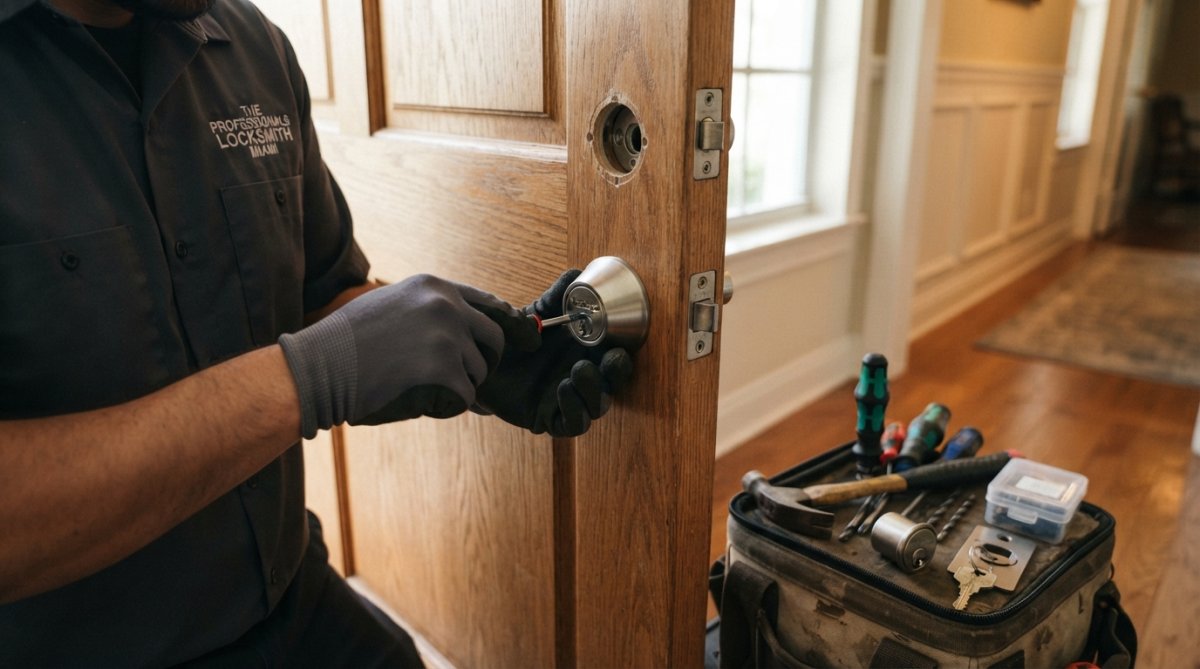
The single most effective way to secure your home is to upgrade the locks on every exterior door. A high-security deadbolt installation gives you the strongest first line of defense against forced entry. At SOUTHMIAMILOCKSMTIH.COM, our technicians have spent over 30 years reinforcing doors across Miami-Dade County.
Why Standard Locks Fail in Miami
Standard builder-grade locks use short screws and soft metal. A firm kick can split the door frame around them. Many Miami homes also sit in high-traffic areas where doors face the street or a shared hallway. That gives an intruder cover and time.
What to Look for in a Deadbolt
Look for three things: a solid steel bolt, a reinforced strike plate, and long mounting screws that reach the stud.
- Bolt throw: at least 1 inch of solid steel
- Strike plate: heavy-duty, secured with 3-inch screws
- Cylinder: pick-resistant and drill-resistant
- Grade: ANSI Grade 1 or Grade 2 rated
2. Upgrade to Smart Locks: Key Smart Lock Benefits for Miami Homes
Smart locks add convenience and control that mechanical locks cannot match. The key smart lock benefits are simple: you can lock up from anywhere, hand out temporary codes, and see who comes and goes. For a busy household or a rental, that changes everything.
Remote Access and Real-Time Alerts
With a smart lock, you get real-time alerts the moment a door opens. You can lock the door from your phone while you are at work. You can also give a contractor a one-time code that expires in a few hours.
The Layer Most Guides Skip: Securing the Network Behind the Lock
A smart lock is only as safe as the network it lives on. Every connected lock, camera, doorbell, and hub is a small computer with a radio, and each one is a possible way into your home network. Most guides stop at "use a strong password." That is the floor, not the ceiling.
Treat the network itself as a security layer:
- Segment the devices. Put smart locks, cameras, and hubs on a separate Wi-Fi network or VLAN from your laptops and phones. If a camera is compromised, the attacker lands on an isolated network instead of next to your banking apps.
- Change every default credential. Routers, hubs, and cameras ship with admin logins that are published in manuals. Change the router admin password and the Wi-Fi password on day one.
- Turn on multi-factor authentication in every lock, camera, and hub app that offers it.
- Keep firmware current. Vendors patch known flaws through firmware updates; an unpatched device is the easiest target in the house.
- Disable features you do not use. Remote access, UPnP, and cloud sharing are conveniences that also widen the attack surface. Turn off what you will not use.
- Check the router. An outdated router without current WPA3 or WPA2 encryption undermines every device behind it. If the router is more than a few years old, replacing it is often the cheapest security upgrade in the home.
Choosing a Lock That Fits the Door
Not every smart lock fits every door, and the wrong pick means a return trip to the store.
- Deadbolt style: A retrofit lock fits over your existing deadbolt's interior side and keeps your current key. A full replacement swaps the whole deadbolt and cylinder.
- Bolt type: Confirm whether your door uses a traditional turn-piece or a thumb-turn cylinder before buying.
- Backup power: Most battery-powered locks warn you before they die, but keep a physical key or a 9-volt jump terminal as a fallback so you are never locked out.
- Connectivity: Bluetooth-only locks work close to the door; Wi-Fi and Z-Wave bridges add remote control but also add a device to secure.
3. Build a Layered Perimeter With Lighting and Cameras
Locks protect the door. A layered perimeter protects the whole property. Lighting and cameras work together to make your home a harder target.
Motion-Activated Camera Placement Strategies
Place cameras where they catch faces, not just movement. Aim them at entry points and the paths people use to approach.
- Front door, at face height
- Back door and side gates
- Driveway and garage
- Any dark corner near a window
Perimeter Lighting That Deters Intruders
Good lighting removes the shadows an intruder needs. Use motion-activated lights at every entry. Add steady low light along walkways and fences. A well-lit home sends a clear message: someone is watching.
4. Harden Against Storms and Fire Hazards
Security is not only about intruders. In this region, wind, water, and fire pose a real threat to your home and your family. Hardening your home means planning for all three at once, and the same upgrades that keep debris out also keep people out.
Build to the High-Velocity Hurricane Zone Standard
Most of the area sits inside the High-Velocity Hurricane Zone (HVHZ), the toughest wind-borne debris region defined by the state's building code. That designation is not trivia, it dictates what products are legal to install and how they must be tested.
- Impact-rated openings: Look for a Florida Product Approval number or a Miami-Dade County Notice of Acceptance (NOA) on the label. A product without one of those two approvals does not meet code for this zone.
- Missile-level rating: The HVHZ test fires a 9-pound 2x4 lumber missile at roughly 34 mph, then cycles the assembly through thousands of positive and negative pressure pulses. A window that passes this is genuinely hard to break.
- Shutter options: Accordion, roll-down, colonial, and panel systems all qualify if they carry the right approval. Permanent track-mounted shutters beat bolt-on panels when a storm turns at the last minute.
- Garage doors: The largest opening in most homes is also the weakest. An unbraced garage door can fail at pressures well below what the rest of the house can take, and once it goes, internal pressure can lift the roof. Ask for a wind-rated door or a bracing kit rated for the zone.
- Roof-to-wall connections: Hurricane straps and clips are what keep the roof deck attached. A roof inspection can confirm whether yours are present and properly nailed.
Why This Matters for Insurance
Wind mitigation is one of the few home upgrades that can pay you back. Insurers in the state are required to offer discounts for verified wind-mitigation features, and the inspection form used to document them, the Uniform Mitigation Verification Inspection, credits specific items like impact-rated glazing, shutter coverage, a secondary water barrier, and roof-to-wall straps.
- Complete the hardening work.
- Hire a licensed inspector to perform the wind mitigation inspection.
- Send the completed form to your carrier and ask for the credit to be applied.
Fire and Everyday Hazards
Fire is a quieter risk that many homeowners ignore. Keep fire extinguishers in the kitchen, garage, and near any workshop area, and check the gauge every few months. A multipurpose ABC-rated extinguisher covers the trash, wood, paper, grease, and electrical fires most homes actually see.
- Test smoke and carbon monoxide alarms monthly
- Keep an emergency supply kit stocked with water, batteries, and a hand-crank radio
- Store important documents in a fireproof and waterproof safe
5. Schedule Professional Residential Locksmith Services
A professional security audit finds the weak spots you cannot see. Residential locksmith services cover far more than lockouts. A trained eye can spot a failing lock, a loose frame, or a gap in your coverage before it becomes a problem.
What a Security Audit Covers
A full audit walks every entry point in your home. It checks lock function, door frames, strike plates, and hardware wear. It also reviews your lighting and camera placement.
Rekeying vs. Replacing Locks
Rekeying changes the pins inside a lock so old keys no longer work. Replacing swaps the whole lock for a new one.
- Rekey when the lock is in good shape but the keys are not secure
- Replace when the lock is worn, damaged, or low quality
- Rekey after moving in, or after a roommate or renter leaves
| Situation | Best Option | Why |
|---|---|---|
| Just moved in | Rekey | Old keys stop working |
| Worn or sticking lock | Replace | Internal parts are failing |
| Rental turnover | Rekey or smart lock | Fast, code-based access |
| Upgrading security | Replace | Adds Grade 1 hardware |
How the Best Ways to Secure Your Home in Miami Work Together
No single step makes a home safe on its own. The 5 best ways to secure your home in Miami work as a system. Strong locks slow an intruder. Lighting and cameras remove cover. Storm and fire prep protect against other threats. A professional audit ties it all together.
Frequently Asked Questions
What are the most effective ways to secure a residential property in Miami?
Start with high-security deadbolt installation on every exterior door, then add smart locks with real-time alerts. Layer in motion-activated cameras, perimeter lighting, and impact-resistant windows. Schedule a professional security audit with a licensed residential locksmith to identify weak points. In Miami, storm-rated hardware and flood mitigation also matter because forced entry and storm damage often overlap. Combining physical reinforcement with technology gives you the strongest defense.
Are smart locks a reliable security upgrade for Miami homes?
Yes, when installed correctly. Smart locks offer keyless entry, remote monitoring, and real-time alerts that let you control access from your phone. The main smart lock benefits include eliminating hidden spare keys and tracking who enters your home. However, cybersecurity matters. Use two-factor authentication and keep firmware updated. A certified locksmith can confirm your door frame and strike plate support the lock's weight before installation.
How often should I have my residential locks inspected by a professional?
Once a year is a good baseline, but Miami's humidity and salt air accelerate wear on metal components. Inspect after any storm or attempted break-in. Signs you need service include sticky keys, loose cylinders, or visible rust. A residential locksmith can rekey cylinders, tighten mounting screws, and check deadbolt reinforcement. If your building has an old master key system, ask whether it can be updated rather than replaced entirely.
What role do high-security deadbolts play in home protection?
High-security deadbolts resist picking, drilling, and bumping far better than standard cylinders. Look for ANSI Grade 1 or Grade 2 ratings and hardened steel bolts at least 1 inch long. In high-velocity hurricane zones, the door itself must also meet impact standards, so pair the deadbolt with a reinforced strike plate and solid-core or impact-rated door. A locksmith certified in brands like Medeco or Mul-T-Lock can match the right hardware to your door.
Securing a home takes more than one upgrade. It takes the right locks, the right placement, and a pro who knows the local risks. SOUTHMIAMILOCKSMTIH.COM brings over 30 years of experience, certified technicians in Medeco and Multlock locks, and full residential, commercial, and automotive service. Get started with SOUTHMIAMILOCKSMTIH.COM and secure your home with hardware built to last.